
CBP IEEPA Refund Update: CAPE & Recon

🔓Discover how CBP Updates IEEPA Refund Guidance: CAPE & Reconciliation affects your business. Learn about CAPE filings, duty refunds, and compliance.
Summary: U.S. Customs and Border Protection (CBP) has issued updated guidance on IEEPA duty refunds and CAPE reconciliation filings, clarifying how importers should manage reconciliation entries impacted by refund claims. The update confirms that CAPE filings do not prevent reconciliation, recommends delaying Entry Type 09 filings where possible, and signals that additional guidance is expected. Businesses affected by IEEPA duties should carefully review their filing strategy to reduce delays and compliance risks. |
CBP Updates IEEPA Refund Guidance: Key Points for Importers on CAPE & Reconciliation

The U.S. Customs and Border Protection (CBP) has issued an important update regarding IEEPA duty refunds and reconciliation filings, offering greater clarity for businesses navigating the Consolidated Administration and Processing of Entries (CAPE) system.
For importers affected by International Emergency Economic Powers Act (IEEPA) duties, the latest guidance, published on 26 May 2026; confirms that CBP is actively developing solutions for reconciliation entries impacted by CAPE filings.
This is a significant update for businesses seeking duty refunds while managing customs compliance obligations.
What Is Happening?

CBP has confirmed that it is currently working on a phased solution for processing entries flagged for reconciliation that are also included in a CAPE declaration.
This applies to:
Unliquidated entries, or
Liquidated entries (not more than 80 days beyond the liquidation date)
covering Entry Types 01, 02, and 06, where an Entry Type 09 reconciliation filing has not yet been submitted at the time of CAPE acceptance.
In practical terms: CAPE filings do not prevent reconciliation filings.
However, timing is becoming increasingly important.
Key Updates Importers Need to Know
1. CAPE Filings Do NOT Prevent Reconciliation
One of the biggest concerns among the trade community has been whether filing a CAPE declaration would stop an importer from reconciling entries.
CBP’s answer is clear: No, CAPE declarations do not block reconciliation.
This gives businesses greater flexibility in recovering duties while remaining compliant with customs obligations.
2. CBP Recommends Delaying Reconciliation Filings (When Possible)
CBP recommends that businesses hold Entry Type 09 reconciliation filings, where possible, to allow CAPE refunds to process first.
This recommendation applies only where filing deadlines are not close to expiration.
The reason?
Processing refunds first may simplify reconciliation and reduce administrative complications later.
In simple terms: Refund first. Reconcile second.

3. Additional Guidance Is Coming
CBP has confirmed that additional operational guidance will be provided via the Cargo Systems Messaging Service (CSMS).
Businesses should expect further updates covering:
Filing procedures
Reconciliation requirements
System implementation details
Deadline guidance
This suggests that the CAPE process will continue evolving throughout 2026.
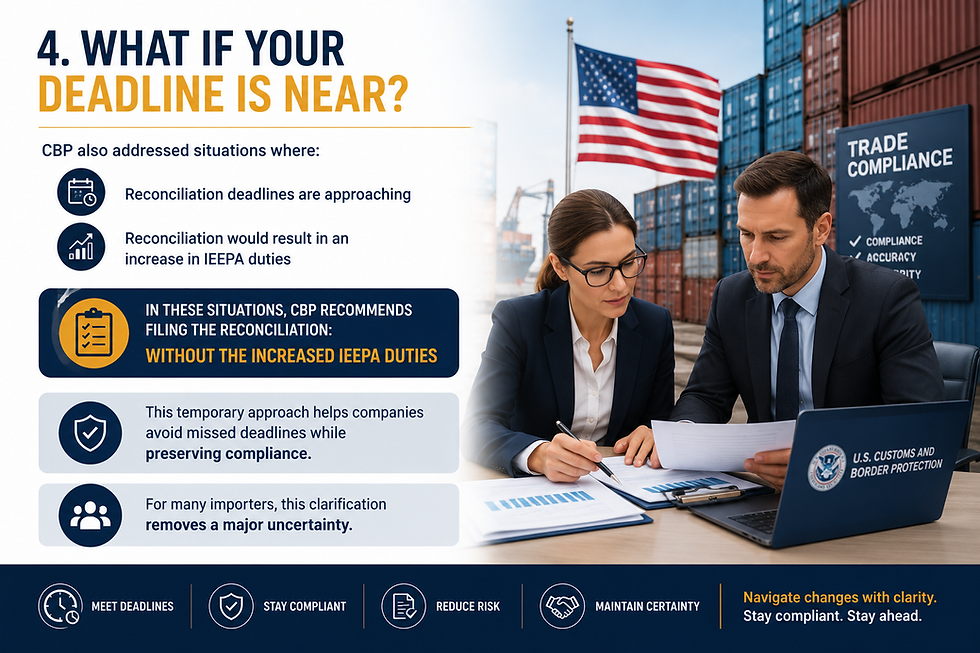
4. What If Your Deadline Is Near?
CBP also addressed situations where:
reconciliation deadlines are approaching, and
reconciliation would result in an increase in IEEPA duties.
In these situations, CBP recommends filing the reconciliation: Without the increased IEEPA duties
This temporary approach helps companies avoid missed deadlines while preserving compliance.
For many importers, this clarification removes a major uncertainty.
Why This Matters for Businesses
The CAPE system represents a major opportunity for companies that previously paid significant IEEPA duties and may now be eligible for refunds.
However, with opportunity comes complexity.
Businesses now need to carefully coordinate:
CAPE refund filings
Reconciliation deadlines
Entry Type requirements
Internal customs data management
A poorly managed filing strategy could result in delays, missed opportunities, or unnecessary compliance exposure.
For importers trading heavily with the U.S., staying informed is becoming essential.
Need Help Understanding CAPE & IEEPA Refunds?
At Customs Manager Ltd, we help businesses navigate complex customs procedures through:
Expert Consultancy & Advice
Understand how CAPE filings, IEEPA refunds, and reconciliation requirements impact your specific business operations.
Specialized Training
We offer live, on-demand, and in-house training covering U.S. customs procedures, ACE filing systems, customs compliance, and trade regulations.
Actionable Trade Intelligence
Stay ahead of customs, sanctions, and export controls developments through our weekly EU, UK, and U.S. regulatory intelligence updates.

U.S. & UK Customs Clearance Support
We support importers with U.S. customs brokerage and UK customs clearance services, helping businesses navigate increasingly complex customs requirements.
[IMAGE PROMPT: A professional infographic showing Customs Manager services: Consulting | Training | Trade Intelligence | Customs Brokerage.]
Final Thoughts
CBP’s latest update is an important step forward for businesses navigating IEEPA refunds and CAPE filings.
The key takeaway?
CAPE and reconciliation can coexist, but businesses must carefully manage timing and filing strategy.
As CBP continues refining the process, businesses that stay proactive will be best positioned to recover duties, reduce risk, and remain compliant.
Sources
Need Support?
Visit www.customsmanager.org for consultancy, training, and customs support services.
Explore our trade intelligence platform at www.customsmanager.info for weekly customs and global trade insights.
Related Topics
Author:
Annkaren Wambui, Growth Partner, Customs Manager Ltd
Updated: May 2026
Disclaimer
This blog is for informational purposes only and does not constitute legal or professional advice. Please consult a customs specialist regarding your specific compliance obligations.


Comments