
Getting Started With CBAM (EU)

An overview of CBAM for individuals seeking to grasp the fundamental concepts of the EU's CBAM regulation.

Table of Contents
1. Executive Summary
2. Introduction
3. Understanding CBAM
- The Transitional Phase (2023-2026)
- Definite Phase (from 2026)
4. The CBAM Report
5. Looking Ahead
6. Conclusion and Takeaways
7. Action You Can Take Now
Executive Summary
This guide helps you to get started with the Carbon Border Adjustment Mechanism (CBAM), a cornerstone in the EU's climate policy designed to mitigate carbon leakage and promote fair competition.
Who are we?
As experts in CBAM, Customs Manager Ltd provides an insightful overview of CBAM's transitional and definitive phases, including practical steps for compliance and strategic recommendations for businesses. Our expertise encompasses training on CBAM, additional support tools, thought leadership, and much more, equipping stakeholders to design and implement effective CBAM strategies.
Why CBAM?
As climate change continues to pose a global challenge, collective action is crucial.
The European Union is stepping up its climate ambitions, but varying climate policies across the world risk undermining these efforts.
This risk is known as "carbon leakage," where companies might relocate carbon-intensive production to countries with looser climate regulations, or where EU products are substituted by more carbon-intensive imports.
To tackle this, the EU has introduced the Carbon Border Adjustment Mechanism (CBAM), a groundbreaking tool to ensure a fair carbon price on imported goods, aligning it with the carbon cost of domestic production.
How does CBAM work?
CBAM is designed to equalize the carbon price of imports with that of goods produced within the EU. By confirming that the carbon emissions embedded in imported goods have a price, CBAM supports the EU’s climate goals and encourages cleaner production practices worldwide.
Will the other countries accept it?
This mechanism is structured to comply with World Trade Organization (WTO) rules.
The Transitional Phase (2023 – 2025)
Starting October 1, 2023, CBAM entered its transitional phase. This period serves as a pilot to gather data and refine methodologies before the full implementation in 2026. During this phase, importers are required to report the greenhouse gas emissions embedded in their imports without the obligation to buy CBAM certificates.
Key Points of the Transitional Phase:
Reporting Emissions: Importers must report both direct and indirect emissions of imported goods.
Flexibility in Reporting: Until the end of 2024, companies can choose from three reporting methods: the new EU method, an equivalent method, or default reference values (valid only until July 2024).
Transition to Full Reporting: From January 1, 2025, only the EU method will be accepted, with limited use of default values.
Transitional CBAM Registry: We are reporting to a temporary registry, not the final one
No Payment: We are not required to make any CBAM payments.
The Definitive Regime (from 2026)
From 2026, CBAM will fully apply, requiring EU importers to:
Register with National Authorities: Importers must register and purchase CBAM certificates from national authorities.
Declare Emissions: Declare the embedded emissions of imported goods annually and surrender the corresponding certificates.
Adjust for Carbon Price Paid: If a carbon price has been paid in the country of origin, the equivalent amount can be deducted from the CBAM obligation.
Sectors Covered
Initially, CBAM targets the most carbon-intensive sectors at risk of carbon leakage:
Cement
Iron & Steel
Aluminium
Fertilisers
Electricity
Hydrogen
Practical Guidance for Importers
The CBAM Report
The EU's Carbon Border Adjustment Mechanism (CBAM) Transitional Registry serves as a centralized digital platform aimed at streamlining the reporting process for importers' carbon emissions associated with goods imported into the EU during the transitional phase of CBAM implementation.
Through a structured system, importers, after registration with their respective National Competent Authority, gain access to the CBAM Declarant Portal within the registry. Here, they submit quarterly reports detailing the carbon content of imported goods, supported by tools like XSD files and sample ZIP files for data submission. You can get these from our CBAM file share where we post updates, see here.
Important Dates
First Reporting Period Ended: January 31, 2024
Transition to Full Reporting: January 1, 2025
Definitive Regime Starts: January 1, 2026
For further assistance, contact your National Competent Authority.
Guidance
The European Commission has developed various tools and resources to support importers during this transitional phase:
CBAM Transitional Registry: A platform where importers can perform and report their CBAM obligations.
User Manuals and IT Tools: Detailed guides, tutorials, and IT updates to facilitate compliance.
You can get these from our CBAM file share where we post updates, see here.
Learn About CBAM in this Introduction Webinar
Learn about CBAM in under 4 hours
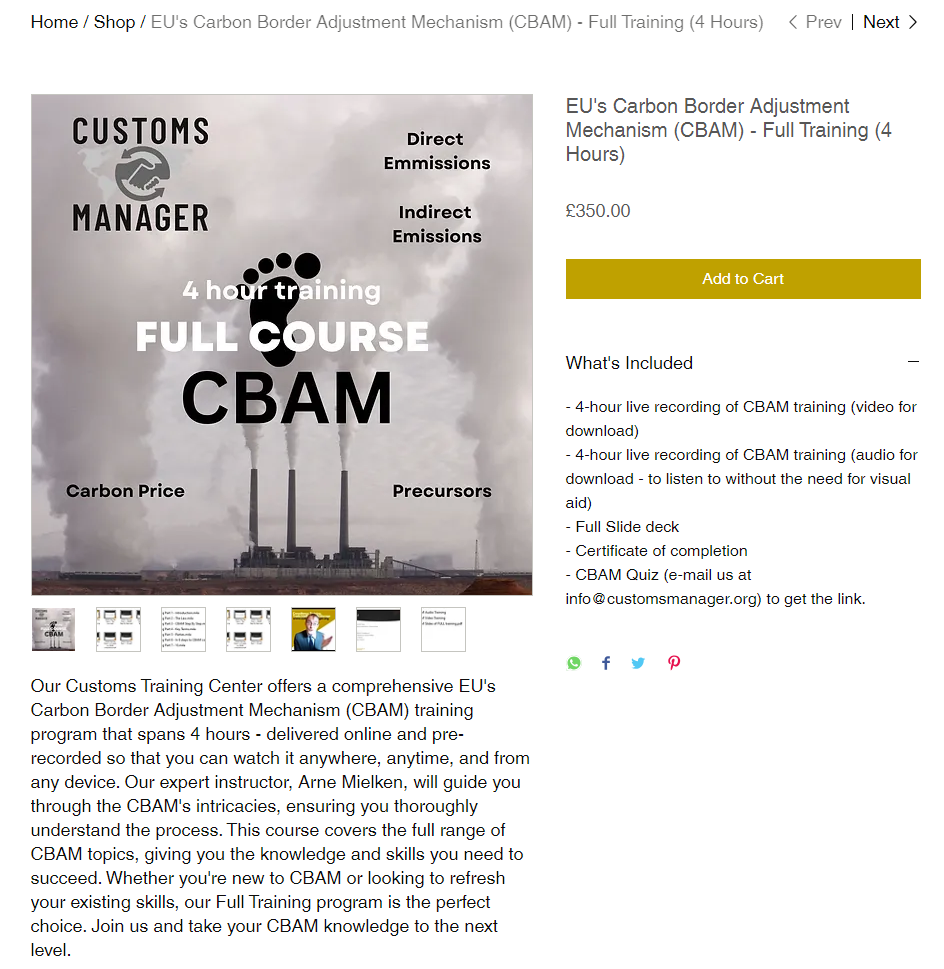
Explore the world of On-Demand prerecorded training on CBAM, a comprehensive platform designed to provide you with all the essential information you need. With this innovative training approach, you can delve deep into the intricacies of CBAM - the Concerns-Based Adoption Model. Gain a thorough understanding of the principles, methodologies, and applications of CBAM through a series of meticulously crafted training modules. This self-paced learning experience allows you to absorb the material at your convenience, ensuring that you grasp the concepts effectively. Find out more here
Conclusion and Takeaways
The EU's Carbon Border Adjustment Mechanism represents a bold and innovative approach to tackling carbon leakage and advancing climate goals.
Action You Can Take Now
Educate Your Team: Leverage Customs Manager Ltd's expert trainings on CBAM to ensure your team is well-informed and prepared. To find out more about our approach to training, visit www.customsmanager.org
Utilize Support Tools: Access & review all our support guides to learn more about CBAM. All support tools can be accessed via our file share
Develop Your CBAM Strategy: Schedule a first free call with Customs Manager Ltd to collaboratively design a tailored CBAM strategy that aligns with your business objectives and compliance requirements. To find out how, visit www.customsmanager.org
Review more materials on this website.


Comments