
EU Digital Passport Goes Live
- Annkaren Wambui

- Jun 25
- 5 min read
🔓 The EU's Digital Product Passport launches on July 19, 2026, revolutionizing product transparency and compliance. Don't get left behind!
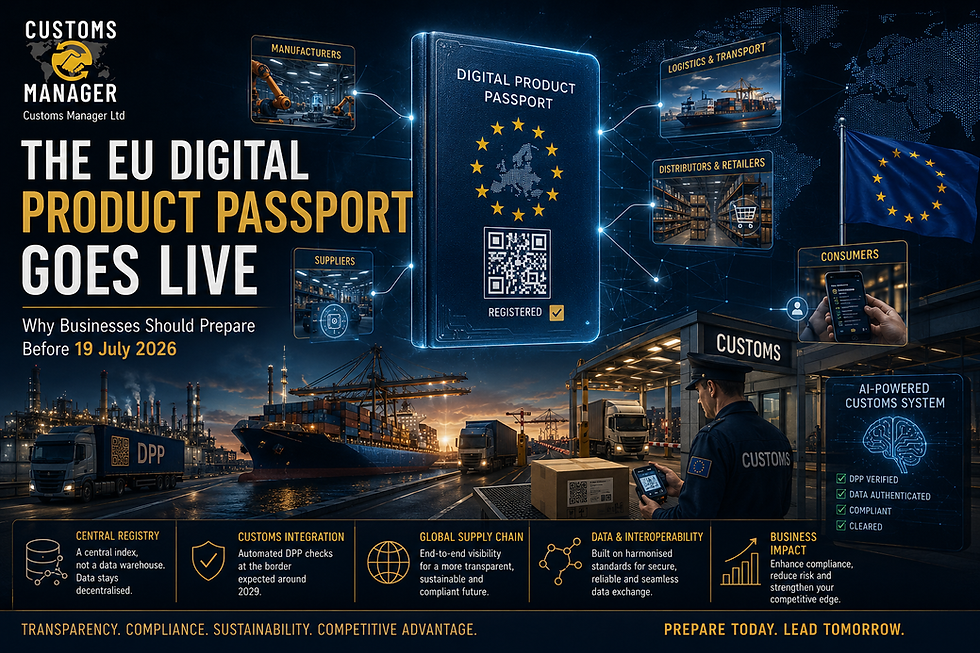
SUMMARY: The Digital Product Passport (DPP) is moving from regulatory concept to operational reality. On 19 July 2026, the EU launches the Digital Product Passport Registry, marking the beginning of a new era in product transparency, customs compliance, and supply chain visibility. While customs integration is still several years away, businesses that wait for the final rules before preparing may already be behind. |
What Is Happening On 19 July 2026?

The European Commission has published its first official Frequently Asked Questions (FAQ) on the Digital Product Passport (DPP) under the Ecodesign for Sustainable Products Regulation (ESPR).
Although individual product requirements will continue to be introduced through delegated acts, 19 July 2026 marks the launch of the Digital Product Passport Registry.
For many businesses, this represents the moment when the DPP moves from policy discussion to practical implementation.
The Registry itself is not a database containing product information.
Instead, it acts as a central index that connects users to product information stored and managed by manufacturers, importers, or specialist service providers.
Why Does It Matter For Trade?

The Digital Product Passport is about far more than sustainability.
It introduces a new digital infrastructure that will eventually support customs, market surveillance, and supply chain transparency across the European Union.
One particularly important development concerns customs.
According to the European Commission, automated customs verification of Digital Product Passports is expected within approximately four years.
Once implemented, customs systems may automatically verify whether a required Digital Product Passport exists before goods are cleared.
For importers, exporters, and customs brokers, this represents a significant operational shift.
Which Products Could Be Affected?

The European Commission has outlined an indicative rollout timetable.
Current planning suggests:
2026 – Iron & Steel
2027 – Textiles, Tyres and Aluminium
2028 – Furniture
2029 – Mattresses and ICT Products
However, businesses should remember that inclusion within the ESPR Working Plan does not automatically create legal obligations.
A delegated act must still be adopted before Digital Product Passport requirements become mandatory for a particular product group.
What Should Businesses Do Now?

Although many detailed product rules are still being developed, there are several practical actions businesses may wish to consider.
These include:
Reviewing product data management processes.
Assessing digital traceability capabilities.
Monitoring delegated acts affecting relevant product groups.
Preparing suppliers for future Digital Product Passport requirements.
Following harmonised standards currently being developed by CEN and CENELEC.
Waiting for every technical requirement to be finalised could leave businesses with very little time to adapt.
Sources
Regulation (EU) 2024/1781 – Ecodesign for Sustainable Products Regulation (ESPR)
This is the legal framework establishing the Digital Product Passport and the wider Ecodesign for Sustainable Products Regulation.
European Commission – Implementing Regulation for the Digital Product Passport Registry
This implementing regulation sets out how the Digital Product Passport Registry will operate, including its implementation arrangements.
European Commission – Digital Product Passport Registry FAQ
The Commission's first official FAQ explains how the DPP Registry works, the decentralised approach to product data, customs integration, delegated acts, and implementation timelines.
📥 Download the Official DPP Registry FAQ
To complement this article, we have included the official European Commission Digital Product Passport Registry FAQ.
Whether you are a manufacturer, importer, exporter, customs professional, or supply chain manager, this document provides valuable guidance on how the DPP Registry will operate and what businesses should expect as implementation progresses.
Download your copy below.
Final Thoughts
The Digital Product Passport is often described as a sustainability initiative.
In reality, it represents something much larger.
It is the foundation of a digital infrastructure that could reshape customs procedures, market surveillance, product compliance, and supply chain transparency across Europe.
For customs professionals, manufacturers, importers, and exporters, the question is no longer whether Digital Product Passports will become important.
The question is how quickly organisations can prepare.
Need Help Preparing For The Digital Product Passport?
At Customs Manager Ltd, we help businesses prepare for evolving product compliance, customs, and trade requirements through:
Expert Consultancy & Advice
Understand how the Digital Product Passport, ESPR, customs compliance, product traceability, and supply chain transparency may affect your operations.
Specialized Training
We offer live, on-demand, and in-house training covering Digital Product Passports, CBAM, EUDR, tariff classification, Rules of Origin, customs valuation, and global trade compliance.
Trade Compliance Support
We help businesses strengthen product data management, improve documentation, and prepare for evolving EU customs and sustainability requirements.
Actionable Trade Intelligence
Stay ahead of customs and regulatory developments through our weekly trade intelligence updates, helping businesses monitor key changes across the EU, UK, U.S., and global trade landscape.

About Customs Manager’s Customs & Global Trade Intelligence Services
Our Professional Legislative Monitoring Service (PLM) is a research and curation service that monitors legislative updates from official government websites across selected jurisdictions and topics.
PRO Plan subscribers can access regular law change notifications to ensure they never miss a significant legal change on www.customsmanager.info – a website dedicated to customs & trade intelligence providing vital thought leadership development services to empower them to trade effectively, efficiently, and, of course, compliantly, across borders.
Pro Subscribers can add jurisdictions and topics for an additional charge to receive white-label intelligence services tailored to their industry. To find out more, contact us by emailing info@customsmanager.org
About Customs Manager Ltd.
We aim to empower people with import, export, and transport responsibilities with helpful advice, insightful training, relevant trade intelligence, and EU, UK, and U.S. direct and indirect customs clearance services. We devote all our passion and energy to helping businesses grow faster cross-border.
Working with us means having your own multilingual Customs Manager on standby to help you trade effectively, efficiently, and, of course, compliantly wherever you want to go. Includes Brexit & U.S. Tariff support.
Main Website: www.customsmanager.org
Dedicated Trade intelligence website: www.customsmanager.info
E-Mail: info@customsmanager.org
LinkedIn: https://www.linkedin.com/company/69768402/admin/
Free Information and Updates:
Weekly Newsletter: Subscribe Here
Weekly Videos (YouTube): Ask the Customs Manager for video messages by Arne Mielken answering your questions, insightful interviews, bite-sized info videos, and more. Subscribe for free here:
Related Topics
#DigitalProductPassport #DPP #ESPR #ProductCompliance #TradeCompliance #CustomsCompliance #CircularEconomy #SupplyChain #EUCustoms #GlobalTrade
Author:
Annkaren Wambui | Growth Partner at Customs Manager Ltd.
Updated: June 2026
Disclaimer
This blog is for informational purposes only and does not constitute legal or professional advice. Please consult a customs specialist regarding your specific compliance obligations.


Comments