
Unpacking the EU Generalized System of Preferences: Your Ultimate Guide

A Comprehensive Guide to Understanding the EU Generalized System of Preferences
The General Scheme of Preferences (GSP) of the European Union (EU) removes import tariffs on goods entering the EU market from vulnerable developing countries. This step aims to help those nations fight poverty and create job opportunities based on international values and principles, which include people's and workers' rights, climate and environmental protection, and good governance. Please note that the GSP is reviewed and amended annually.
Over fifty years ago, the UNCTAD urged developed nations to assist developing nations to join the global economy. This resulted in the establishment of the Generalised System of Preferences (GSP), which is now adopted by approximately a dozen countries.
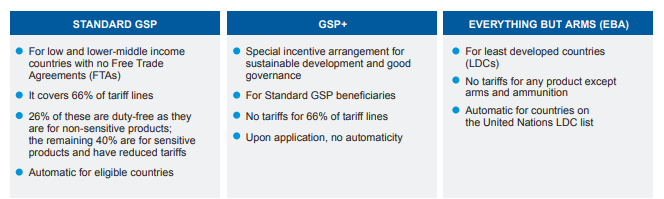
The GSP has three agreements:
Standard GSP: for countries with low or low-middle income, which means that two-thirds of tariff lines will have some or all of their customs duties waived.
GSP+: a special incentive plan for good governance and sustainable development. GSP+ eliminates these same tariffs to 0% for vulnerable low- and lower-middle-income countries that comply with 27 international conventions on labor and human rights, environmental and climate protection, and good governance.
EBA "Everything But Arms," a special arrangement for the least developed countries (LDCs) that provides them with duty-free and quota-free access to the EU market for all products except arms and ammunition.
Preference requirements are given to developing countries that meet the following criteria:
They have an income that is below what the World Bank defines as "upper middle income".
They do not have special access to the EU market through an agreement or any other means.
They are on the list of countries that can join, as amended (Annex II of the central regulation).
If a country desires GSP+ status, it must ratify 27 international conventions and work with the European Commission to ensure that they are followed. These conventions are about protecting the environment, the climate, and promoting good governance. They are listed in the GSP Regulation.
Even if an LDC (least developed country) already has another arrangement, it automatically benefits from the "Everything But Arms" arrangement.
All countries that receive GSP assistance must respect the rules of the fifteen core conventions on human rights and workers' rights. These conventions are:
Core human and labour rights UN/ILO Conventions:
Convention on the Prevention and Punishment of the Crime of Genocide (1948)
International Convention on the Elimination of All Forms of Racial Discrimination (1965)
International Covenant on Civil and Political Rights (1966)
International Covenant on Economic, Social and Cultural Rights (1966)
Convention on the Elimination of All Forms of Discrimination Against Women (1979)
Convention Against Torture and other Cruel, Inhuman or Degrading Treatment or Punishment (1984)
Convention on the Rights of the Child (1989)
Convention concerning Forced or Compulsory Labour, No 29 (1930)
Convention concerning Freedom of Association and Protection of the Right to Organise, No 87 (1948)
Convention concerning the Application of the Principles of the Right to Organise and to Bargain Collectively, No 98 (1949)
Convention concerning Equal Remuneration of Men and Women Workers for Work of Equal Value, No 100 (1951)
Convention concerning the Abolition of Forced Labour, No 105 (1957)
Convention concerning Discrimination in Respect of Employment and Occupation, No 111 (1958)
Convention concerning Minimum Age for Admission to Employment, No 138 (1973)
Convention concerning the Prohibition and Immediate Action for the Elimination of the Worst Forms of Child Labour, No 182 (1999)
The European Commission has recently reviewed and renewed the regulation governing the Generalised Scheme of Preferences (GSP), until 2027.
Eliminating GSP preferences may be simplified
The European Commission proposes changes to the withdrawal process that would enable the European Commission to respond more flexibly and promptly to egregious and systematic breaches of the covered conventions, in tandem with strengthening the conditionality under the GSP Regulation. To ensure that each country's unique circumstances are considered, the idea includes conducting socio-economic impact assessments as part of the withdrawal process. The Commission also suggests integrating other variables, such as migratory status, in its analysis (see a legislative proposal, page 20). In addition, the Commission now has more clout on good governance and environmental protection because of the expansion of the list of incorporated treaties and the addition of negative conditionality.
GSP+ Monitoring under the new GSP
The European Commission has proposed tangible actions to increase the openness of the GSP+ monitoring, as suggested by the Mid-Term Evaluation. The monitoring procedure, including how different parties were involved, should be described in depth and made public. Further, the European Commission recommends extending the GSP monitoring cycle from two to three years, as recommended by the Mid-Term Evaluation and the Study on the Review of the GSP Regulation. This would synchronise the reporting periods of binding international treaties with the GSP+ monitoring.
Product graduation and protections: From Volume to Value
In this proposal, the Commission considers determining safeguard levels not by import volumes but by import values. This would make it consistent with how the graduation requirements are determined. Products with lower levels of competition and nations with the greatest need for preferential access should be the primary emphasis of any future GSP framework. Consequently, the proposal recommends a 10% reduction in product graduation and safety limits. The EBA exempts from safeguard measures any country whose imports into the EU account for less than 6% of the total for the items in question. The normal GSP recipient nations are the only ones who may use the product graduation method.
Rules of Origin under GSP
For your product to get special treatment, it needs to meet the rules of origin set out in the agreement. Origin is the "economic country of origin" of traded goods. If you are new to the subject, this Guide will give you an overview of the main ideas.
The following legal documents spell out the rules of origin:
Articles 37 and 41–58 of Regulation (EU) 2015/2446 of the Commission from July 28, 2015
Articles 60 and 70–112 of Commission Implementing Regulation (EU) 2015/2447 of November 24, 2015
Commission Regulation (EU) 2015/2446 of July 28, 2015, Annex 22-03
Please keep in mind that these are all-encompassing rules that don't just cover origin. However, the Commission's Guide for Users on GSP rules of origin has an unofficial consolidated version of the legal text about GSP rules of origin. Access this Guide here
Does my product benefit from GSP preferences?
To qualify for lower or no preferential tariffs, your product must originate from a country that is a beneficiary of the Generalized System of Preferences (GSP). A product can be considered to have originated from a GSP beneficiary country if it meets one of these criteria:
It is entirely obtained in a beneficiary country.
It is obtained in a beneficiary country and contains materials that have not been wholly obtained but have been worked or processed enough. The product-specific rules in Annex 22-03 of Commission Delegated Regulation (EU) 2015/2446 define the extent of this processing.
Annex 22-03 has two sets of rules, one for the Least Developed GSP beneficiary countries and one for all other GSP beneficiary countries.
EU trade agreements have product-specific rules that fall into these main categories:
The value-added rule sets a limit on the value of a product’s non-originating materials as a percentage of the product's ex-works price.
Changing the tariff classification of non-originating materials and the final product by making something. For instance, making paper (Harmonized System Chapter 48) from non-originating pulp changes the tariff classification of the paper (Harmonized System Chapter 47).
Specific operations, such as spinning fibers into yarn, require a specific production process.
These rules are mainly used in the textile, clothing, and chemical industries.
Tips to help you meet the rules of origin for your product
More flexibility is planned to help you follow the rules specific to a product, like tolerance or cumulation.
Tolerance
The tolerance rule in the GSP allows producers to use non-originating materials that are usually prohibited by the product-specific rule. However, this is only permitted if the net weight or value of such materials does not exceed a certain limit.
For agricultural and processed agricultural products in Chapters 2 and 4 to 24 of the Harmonized System (excluding processed fishery products in Chapter 16), the limit is 15% of the product's weight. For industrial goods that are not textiles or clothing, the limit is 15% of the product's ex-works price.
Specific tolerances that apply to textiles and clothing in Harmonized System Chapters 50 to 63 can be found in Notes 6 and 7 of the Annex. Additionally, the list in Annex 22-03 contains explanatory notes.
It's important to note that this tolerance cannot be used to exceed any of the product-specific rules' maximum-value thresholds for non-originating materials.
Cumulation
The GSP allows you to add up the origin of a product in two ways:
1. Bilateral cumulation: This lets you count materials from the EU as if they came from the GSP beneficiary country when used to make a product.
2. Regional cumulation: This allows countries in specific groups within the same region to combine their points.
At present, this point system applies to...
I. Group
Cambodia
Indonesia
Laos
Myanmar/Burma
Philippine Islands
II. Group
Bangladesh
Bhutan
India
Nepal
Pakistan
Sri Lanka
This means that when a product is made, imported materials from the same group of countries can be counted as being made in the country. However, in Annex 22-05, there are some special rules for textile products, and in Annex 22-04, there is a list of products that can't be added across regions.
Cross-regional cumulation lets Group I beneficiary countries and Group III beneficiary countries use the material from the other country as if it were made in their own country. This addition must be asked for; it is not done automatically. At the moment, one of these accumulations is in place.
Extended cumulation lets a beneficiary country ask for cumulation with a country with a Free Trade Agreement with the European Union. At the moment, this does not apply.
When Norway, Switzerland, and Turkey are added together, materials from those three countries can be counted as coming from a beneficiary country when they are used to make a product. Chapters 1 through 24 of the Harmonized System, which cover agricultural goods, are not included in this type of cumulation.
Derogations
Under certain conditions, a specific derogation can be given so that the Rules of Origin for certain products from certain countries can be less strict. Cape Verde has been given this kind of exemption, which is still in place.
Disqualifications
Your product must also meet the other Protocol requirements that apply (such as insufficient working or processing or non-alteration rule).
Originating goods must be moved from a country eligible for the GSP to the EU without being changed in a third country.
Some tasks can be done in a third country if the goods are still under customs control.
Adding or affixing marks, labels, seals, or any other paperwork to make sure they meet the needs of the importing country
Keeping things in good condition storage
Dividing up shipments
The customs officials may ask for proof that the rule was followed, such as
bills of lading and other contracts for transporting goods
factual or concrete evidence based on the way packages are marked or numbered
any proof that has to do with the goods themselves
Duty drawback
Under the GSP scheme, getting back duties already paid on non-native materials used to make a product that is exported under a preferential tariff is possible.
How to ask for a preferential rate
Exporters and importers must follow the procedures for the country of origin. Articles 60 and 70– 112 of Commission Implementing Regulation (EU) 2015/2447 explain how to claim a preferential tariff and how customs officials will check the claim. They explain things like how to say where a product comes from, how to get a tax break, and how customs officials can check the product's origin.
Origin declaration
When bringing goods into the EU, you don't have to show proof of where they came from if the total value of the shipment is less than €500 for small packages or €1,200 for personal luggage.
Sources of proof
Exporters from the beneficiary countries can self-declare that their product is from their country by submitting a statement of origin.
a person or business that has signed up with the Registered Exporter System (REX)
any exporter as long as the whole shipment doesn't cost more than €6,000
A statement of origin is a declaration of origin made by the registered exporter on an invoice, a delivery note, a packing list, or any other commercial document that lets the goods and the exporter be identified. Annex 22-07 of Regulation (EU) 2015/2447 has the text of the origin statement. Articles 92 and 93 of that regulation are the main places to look for rules about the origin statement.
The proof of origin needed to get preferential tariff treatment under the GSP will be a statement of origin from exporters registered in the Registered Exporter System in the beneficiary country (REX). Therefore, Form A certificates can no longer be used after this date.
The origin statement is suitable for a year from its date.
Checking the source
The customs office can check to see if an imported product is really from the country of origin or meets other origin requirements. The GSP is made up of the following ideas:
Administrative cooperation between the customs authorities of the beneficiary country and the EU is used to check the goods.
The customs authorities of the country that receives the goods check to see where the came from, but the Commission or the governments of EU Member States can join in if needed.
Once the check is done, the authorities of the beneficiary country will send the results to the authorities of the EU Member State that asked for them. Those authorities will then make the final determination of origin.
Subscribe to Free Updates
Sign-up at www.customsmanager.org
About Customs Manager’s Trade Intelligence Services
The Premium Professional Legislative Monitoring Service (PLM) is a research and curation service which checks for legislative updates from official government websites, based on the selected jurisdictions and topics. Premium subscribers can access daily (workday) law change notifications, tailored to their preferences, to ensure they never miss an important legal change. At the same time, they save valuable time by engaging our dedicated trade specialists to carry the monitoring out for them. Premium subscribers also unlock all content on the Customs Manager’s Ltd. website, including our Customs & Trade Blog, providing vital thought leadership development services to empower them to trade effectively, efficiently and, of course, compliantly, across borders.
Premium Subscribers can add jurisdictions and topics for an additional charge.
About Customs Manager Ltd.
We are on a mission to empower people with import, export and transport responsibilities with helpful advice, insightful training and relevant trade intelligence services. We devote all our passion and energy to helping businesses grow faster cross-border. Working with us means to have your own multilingual Customs Manager on standby to help you trade effectively, efficiently and, of course, compliantly, wherever you want to go in the world. Includes Brexit support and the ability to lodge customs declarations + Rules of Origin
Stay in Touch
· Website: www.customsmanager.com
· E-Mail: info@customsmanager.com
· Twitter: https://twitter.com/mielkenarne?lang=en
· Linked In: https://www.linkedin.com/company/69768402/admin/
· LEAVE us a POSITIVE REVIEW: https://g.page/customsmanager/review?rc


Comments