
HS 2028: Major Harmonized System Update
- Annkaren Wambui

- Jul 2
- 4 min read
Updated: Jul 6
🔐 The World Customs Organization has approved the 2028 Harmonized System. Discover what the changes mean for importers, exporters, and customs professionals.
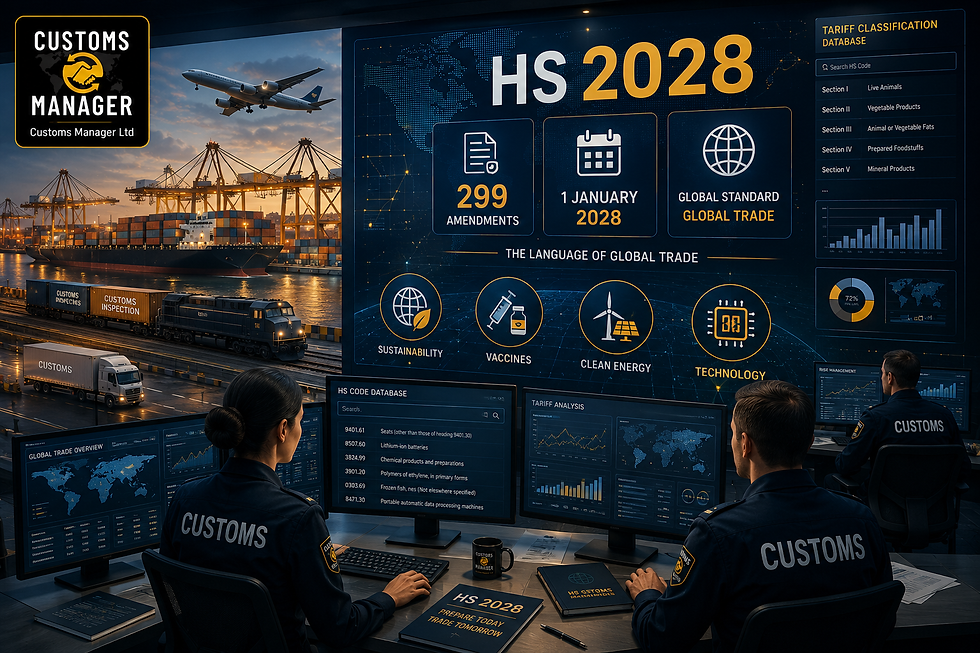
Summary: The World Customs Organization (WCO) has adopted the 2028 edition of the Harmonized System (HS), featuring 299 amendments and updates in sustainability, healthcare, technology, and global trade policy. Businesses should review product classifications before its implementation on 1 January 2028 to ensure compliance and avoid customs disruptions. |
Why This Matters
Most businesses never think about the Harmonized System until a customs declaration is rejected.Unfortunately, by then it may already be too late.
Every customs declaration, tariff rate, Rules of Origin calculation, Free Trade Agreement, customs valuation exercise and trade statistic relies upon one common language:The Harmonized System (HS).
When the WCO updates that language, businesses importing or exporting internationally should pay attention.
The latest revision; the 2028 Harmonized System—introduces hundreds of classification changes designed to reflect how international trade continues to evolve.
What's Changing In HS 2028?

The 2028 edition introduces:
• 299 sets of amendments
• 6 entirely new tariff headings
• 5 deleted headings
• 428 new subheadings
• 172 retired subheadings
While many existing HS Codes remain unchanged, these amendments affect thousands of products traded globally.
Importantly, retired HS Codes rarely disappear altogether. Instead, products are generally reclassified into new headings or subheadings that better reflect evolving technologies, products, and regulatory priorities.
Businesses should never assume the replacement classification.
Every product should be verified against their country's national tariff schedule before implementation.
Why Is The Harmonized System Changing?

The amendments are far from random.
They reflect how governments increasingly use customs tariffs as tools for regulation as well as revenue collection.
Several major themes drive the 2028 update.
🌱 Sustainability
Environmental priorities continue to reshape customs classification.
HS 2028 introduces new provisions covering biodegradable plastics, plastic waste streams and more detailed species-level classifications for timber and fish, supporting global anti-deforestation initiatives and sustainability reporting.
💉 Healthcare
Vaccines receive dedicated classifications for the first time.
As global healthcare supply chains become increasingly important, more accurate tariff classifications will improve trade statistics, customs monitoring and international health policy.
⚡ Technology
The updated tariff recognises emerging industries including clean energy technologies, advanced electronics and new manufacturing sectors.
These revisions ensure customs classification keeps pace with technological innovation.
🌍 Trade Policy
Modern customs tariffs are no longer designed simply to collect revenue.
Increasingly they support:
• Environmental policy
• Strategic trade controls
• Product safety
• Supply chain transparency
• Economic security
The tariff schedule continues to evolve into a sophisticated regulatory framework.
Which Industries Are Most Affected?
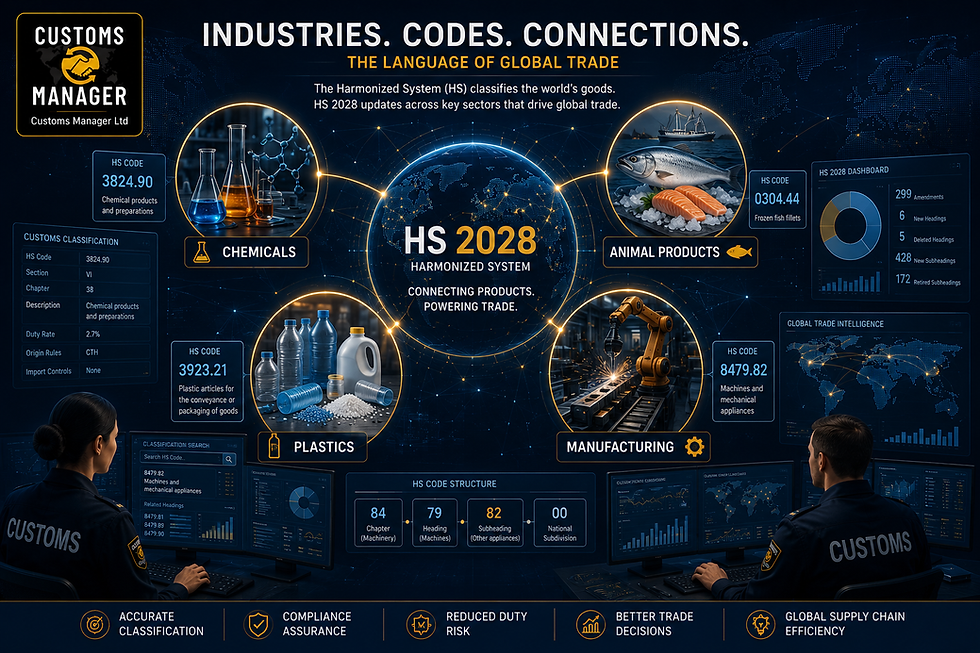
Although every importer should review their classifications, several sectors account for more than half of all HS 2028 amendments.
These include:
• Chemicals
• Animal Products
• Plastics
• Advanced Manufacturing
Businesses operating in these sectors should begin mapping existing classifications well before implementation.
Don't Wait Until December 2027
One of the biggest mistakes businesses make is delaying classification reviews until implementation deadlines approach.
That creates unnecessary pressure across customs, procurement, finance and logistics teams.
Instead, organisations should begin reviewing their product portfolio now by:
✔ Identifying all current HS Codes
✔ Mapping products affected by HS 2028
✔ Reviewing Rules of Origin implications
✔ Checking national tariff schedules
✔ Updating ERP and customs systems
✔ Training internal customs teams
Early preparation significantly reduces implementation risk.
Why Early Preparation Matters
HS restructuring is generally not intended to change customs duty rates at the international level.
However, national tariff schedules may introduce different duty treatments, licensing requirements, origin rules or other trade measures when implementing the revised classifications.
That's why every product classification should be validated before the new system goes live.
Waiting until implementation could expose businesses to declaration errors, delays and unexpected compliance risks.
Need Help Preparing For HS 2028?
At Customs Manager Ltd, we help businesses prepare for major customs changes through:
Customs Classification Reviews
Verify existing HS Codes and identify products affected by future amendments.
Trade Compliance Consulting
Assess how classification changes affect duty rates, Rules of Origin, licensing requirements and customs procedures.
Professional Training
Practical training covering HS Classification, customs valuation, origin, Free Trade Agreements and international trade compliance.
Actionable Trade Intelligence
Stay informed with expert analysis of the latest customs developments affecting the UK, EU, USA and global trade.

Prepare Today For Tomorrow's Tariff Schedule
The 2028 Harmonized System may not take effect until 1 January 2028.
But businesses that prepare early will almost certainly have a smoother transition than those waiting until the last minute.
The language of international trade is changing.
Now is the time to make sure your business is ready.
About Customs Manager’s Customs & Global Trade Intelligence Services
Our Professional Legislative Monitoring Service (PLM) is a research and curation service that monitors legislative updates from official government websites across selected jurisdictions and topics.
PRO Plan subscribers can access regular law change notifications to ensure they never miss a significant legal change on www.customsmanager.info – a website dedicated to customs & trade intelligence providing vital thought leadership development services to empower them to trade effectively, efficiently, and, of course, compliantly, across borders.
Pro Subscribers can add jurisdictions and topics for an additional charge to receive white-label intelligence services tailored to their industry. To find out more, contact us by emailing info@customsmanager.org
About Customs Manager Ltd.
We aim to empower people with import, export, and transport responsibilities with helpful advice, insightful training, relevant trade intelligence, and EU, UK, and U.S. direct and indirect customs clearance services. We devote all our passion and energy to helping businesses grow faster cross-border.
Working with us means having your own multilingual Customs Manager on standby to help you trade effectively, efficiently, and, of course, compliantly wherever you want to go. Includes Brexit & U.S. Tariff support.
Main Website: www.customsmanager.org
Dedicated Trade intelligence website: www.customsmanager.info
E-Mail: info@customsmanager.org
LinkedIn: https://www.linkedin.com/company/69768402/admin/
Free Information and Updates:
Weekly Newsletter: Subscribe Here
Weekly Videos (YouTube): Ask the Customs Manager for video messages by Arne Mielken answering your questions, insightful interviews, bite-sized info videos, and more. Subscribe for free here:
Author
Ann Karen | Head of Growth
Updated: July 2026
Related Topics
#HarmonizedSystem #HS2028 #WCO #CustomsCompliance #TradeCompliance #ImportExport #GlobalTrade #Tariffs #SupplyChainManagement #CustomsManager
Disclaimer
This blog is for informational purposes only and does not constitute legal or professional advice. Please consult a customs specialist regarding your specific compliance obligations.


Comments