
U.S.: CBP Form 7501 Update
- Madni Laghari

- Jul 29, 2025
- 4 min read
Steel and aluminum importers, listen up: CBP just changed the rules. Your supply chain data just became mandatory. Download the latest CBP Form 7501.
If you're in Customs Compliance or Import Regulations, especially in the USA, this change should be on your radar. CBP Form 7501 has just been updated — and it now demands much more detailed origin data for steel and aluminum imports under Section 232. This isn't just an admin update; it’s a seismic shift in how the U.S. enforces tariffs and scrutinizes supply chains.
Who We AreCustoms Manager Ltd. is your trusted partner in navigating complex customs, export controls, and sanctions challenges across the EU, UK, and USA. We offer tailored consultancy, impactful training, and a premium Trade Intelligence Service at www.customsmanager.info, designed to keep you fully informed and ahead of the compliance curve. |
Key Questions Covered in This Blog
What is CBP Form 7501, and why does it matter?
What changes have been made to CBP Form 7501 in July 2025?
Why is this update important for steel and aluminum importers?
What does "Country of Melt, Smelt, Pour, and Cast" mean?
What should compliance teams do to meet the new requirements?
How does this affect supply chain management?
Abbreviations Used In This Blog
CBP – U.S. Customs and Border Protection
Section 232 – U.S. Trade Expansion Act provision imposing tariffs
Melt and Pour – Steel origin reporting terminology
Smelt and Cast – Aluminum origin reporting terminology
"With the new CBP Form 7501 rules, origin data is no longer optional. It’s your compliance lifeline."Arne Mielken, Managing Director, Customs Manager
Fancy a Call?Book a free expert consultation on this topic at www.customsmanager.org → Book Expert Call Get Weekly Game-Changing Updates with The Customs Watch USAStay ahead of U.S. trade policy, enforcement updates, and best practices with The Customs Watch USA – Subscribe at www.customsmanager.info |
What is CBP Form 7501, and why does it matter?
CBP Form 7501, also known as the Entry Summary, is the foundational document for declaring goods into the U.S. It captures everything: classification, valuation, origin, and now, under a July 2025 update, granular data on steel and aluminum origin under Section 232. Think of it as your customs fingerprint—one misstep, and you're flagged. For years, companies could get away with vague origin data. That era is over.
What changes have been made to CBP Form 7501 in July 2025?
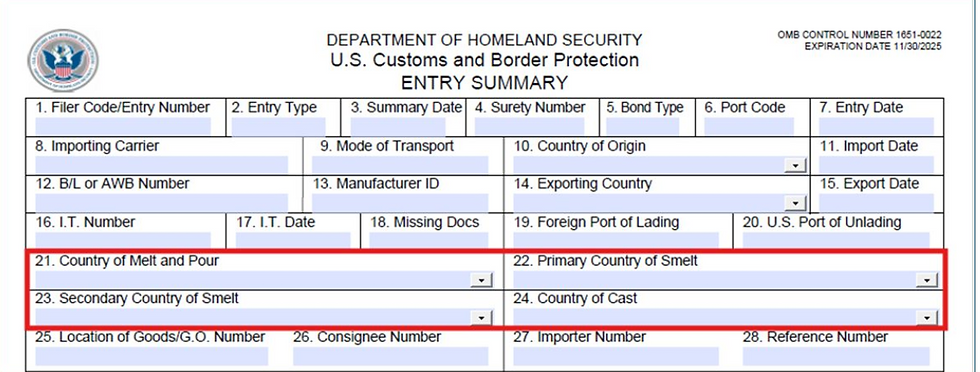
CBP has now added Blocks 21 to 24 to Form 7501 to capture origin specifics:
Block 21: Country of Melt and Pour (Steel)
Block 22: Primary Country of Smelt (Aluminum)
Block 23: Secondary Country of Smelt (Aluminum)
Block 24: Country of Cast (Aluminum)
"N/A" entries? Not accepted anymore. You need traceable, documented evidence for each country you list. This update aligns CBP with global enforcement trends and ensures Section 232 tariffs are applied precisely.
Why is this update important for steel and aluminum importers?
Because traceability is now law. CBP is cracking down on circumvention, transshipment, and origin fraud. These new fields help CBP determine if a product has been manipulated to avoid tariffs. For you, that means faster clearance if you do things right – or penalties, shipment delays, or even market exclusion if you don’t.
What does "Country of Melt, Smelt, Pour, and Cast" mean?
Steel: Melt and pour refers to the country where the raw steel was produced and poured into a solid form – usually at a steel mill.
Aluminum:
Primary Smelt: Where new aluminum is made from alumina.
Secondary Smelt: Where recycled aluminum is processed.
Cast: Where aluminum is liquified and then formed into semi- or fully-finished goods.
This is not abstract theory. You must gather mill certificates, invoices, and origin statements from upstream suppliers. Don’t just "trust your supplier" – verify.
What should compliance teams do to meet the new requirements?
Get proactive. Map your supply chain visually, linking every tier and process. Audit every supplier document. Integrate this origin data into your Customs Compliance systems. You need more than just a spreadsheet – you need real-time access to verifiable evidence. Train your teams, update your SOPs, and establish a zero-tolerance policy for unverifiable origin data.
How does this affect supply chain management?
It fundamentally shifts the burden of proof upstream. If your procurement team doesn’t secure compliant suppliers with full traceability, your customs team pays the price. This is about aligning procurement, logistics, and compliance under a single truth: origin transparency is business-critical.
This also means supply chain mapping is no longer a best practice; it’s a requirement. Visualize your chain, verify every actor, and prepare for audits where you can point to each touchpoint in a shipment’s journey.
Arne’s Takeaway
CBP’s update to Form 7501 may seem like a formality, but it reshapes the compliance landscape for steel and aluminum importers. It’s about control, enforcement, and fairness. If you’re not tracing your materials back to their origin, now is the time to start. Don’t risk penalties or exclusion from the U.S. market.
Expert Recommendations
Immediately audit your current steel and aluminum suppliers.
Collect and store mill certificates, casting records, and smelting documentation.
Train customs, procurement, and logistics teams to align under new requirements.
Use digital tools to track, store, and retrieve origin data.
Book a compliance audit with us to prepare for future CBP inquiries.
Download CBP Form 7501
Sources & Further Information
CBP Cargo Systems Messaging Service (CSMS) #65209321
CBP Form 7501 Instructions
Section 232 Tariff Guidelines
www.customsmanager.info for training, alerts, and newsletters.
Disclaimer
This blog is for general information purposes only and does not constitute legal or compliance advice. Please consult a legal professional for case-specific guidance.
Hashtags
#Customs #TradeCompliance #ImportCompliance #Steel #Aluminum #CBPForm7501 #Section232 #USA #CustomsConsultant #CustomsTraining #ExportCompliance #ImportRegulations #TradePolicy #Sanctions #SupplyChainTransparency #SupplyChainCompliance #CustomsAudit #OriginVerification #USCustoms #CustomsEnforcement #TariffCompliance #RiskManagement


Comments