
The EU Customs Union Reform EXPLAINED

We explain the new EU Customs Union Reform Proposals succinctly and practically - ready for a presentation to the Board or any other stakeholders that matter to YOU.

What can you learn in this post about the EU Customs Union Reform?
Our summary of an EU proposal to reform the EU Customs Union by redrafting the Union Customs Code and establishing an EU Customs Authority. In a way that allows customs professionals to re-use the content for their presentations and information sharing. It has links to more information should you need them.
What this blog is about: EU Customs Union Reform
This explanatory article is about a proposal for a regulation of the European Parliament and of the European Council establishing the Union Customs Code and the EU Customs Authority, and replacing regulation (EU) No 952/2013.
Why reform the EU Customs Union?
The set of suggested EU actions is based on the ten recommendations of the "Wise Persons Group on Challenges Facing the Customs Union" report, which was released in March 2022
This report recommends modifications to the way the EU Customs Union operates to make sure it is appropriate for its intended purposes. The management of e-commerce goods movements and management of EU-wide hazards are the report's two main points of emphasis, both of which demand structural change to be addressed.
A re-write of the general Customs System
A proposed redraft of the Union Customs Code ("UCC") anticipates a rewrite of the general system, which would give the EU Commission authority to enact one or more Delegated Acts (secondary legislation) for particular UCC provisions.
No Delegated or Implementing Acts yet
This proposal is not published with the secondary legislation. What would be covered by the secondary legislation is still uncertain.
Timeframe of EU Customs Union Reform
The proposed revisions to the Union Customs Code are envisaged to be put into effect in accordance with the schedule provided below. It should be emphasised that these suggestions are still in the early stages of consideration and that their application in Northern Ireland is still under consideration/subject to additional engagement with the European Commission.
The time frame for implementation of these recommendations is already rather long.
Additionally, they will need to be approved by the European Parliament and the Council of the EU, which may take up to a year and hence delay implementation even more.

EU Data Hub & Data Sharing - a key element of the EU Customs Union Reform
The European Union is working towards the goal of establishing a system that would enable businesses that bring goods into the EU to record all of the information on their products and supply chains into a unified online environment.
By having all declarations handled centrally in an EU Data Hub rather than by the EU Member States, the reforms to the UCC seek to cut costs by between €1.5bn and €2.6bn per year by the end of the programme, in addition to measures aimed at enhancing compliance/increasing customs income.
An important aspect of implementing the new proposals will be the release of the Implementing and Delegated Acts, which will outline the specific steps to be taken. However, these legislative texts are not expected to be published until at least 2024. Additionally, there are several key timelines to keep in mind for the proposed UCC:
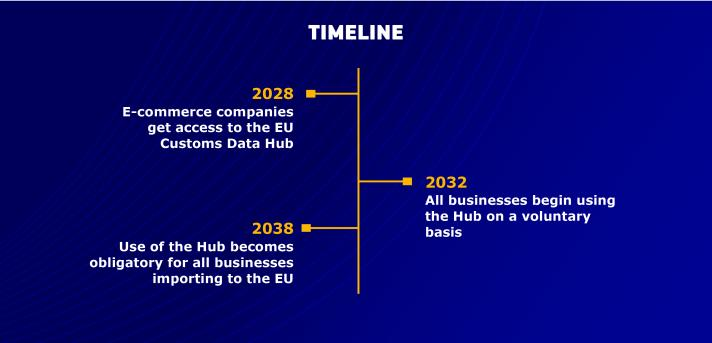
- 2028: EU Customs Authority and proposed e-commerce changes introduced
- 2032: EU Customs Data Hub for Trust and Check traders introduced
- 2035: EU Customs Data Hub for non-Trust and Check traders introduced
- 2038: EU Customs Data Hub becomes mandatory for all traders.
In other words, the fifteen-year project will be completed in phases:

In the words of the EU Commission, the simple timeline is:
Trust & Check Traders - core of the EU Customs Union Reform
A new category of the most trustworthy traders ('Trust and Check' traders) is introduced.
Today, as you know, the EU may grant the so-called "Authorised Economic Operator (AEO)" status to companies that can show safe international supply chains and complying customs regulations.
This designation offers importers and exporters some customs benefits.
The 'Trust and Check' concept will give more benefits than AEO status and will need more open business procedures and supply chains so that merchants may release their products into circulation without any active customs involvement.
The Commission considers that compelling merchants to offer customs officials access to their electronic systems, allowing record keeping of their adherence and precise movements of their products, would promote compliance.
The 'Trust and Check' designation will be offered to enterprises on an EU basis.
E-Commerce & Low-value Imports in the EU Customs Union Reform
In response to the significant increase in ecommerce imports into the EU, the European Commission proposes repealing the current customs duty exemption for all movements worth less than €150 and replacing it with a new method of collecting customs duty on e-commerce movements beginning in 2028.
The Commission considers that, in addition to increasing income from consignments below the threshold, this will discourage avoidance practices such as consignment splitting and/or undervaluation. According to the Commission, this encourages fair competition with EU-based e-commerce companies. All e-commerce transactions in which the sale was facilitated by an online marketplace will be subject to duty payment, avoiding customers from being shocked by costs when acquiring items via an online marketplace. At this point, it is unclear what the proposal's administrative effect would be.
Practically, a change to the Duty Relief Regulation would end the current exemption from customs duty for shipments valued at under €150. This combined with a change to the Combined Nomenclature would allow non-excise goods to be imported without identifying tariff classification, customs value, or origin, subject to customs duty at the five rates. These two revenue-raising customs proposals are to take effect on 1 March 2028.
Additionally, there is proposed legislation that would eliminate the €150 per consignment cap now imposed on the "deemed supplier" under the Principal VAT Directive (online).
As a result, all EU customer sales into the EU (regardless of amount) be VAT and customs-duty-free, meaning that the e-commerce operator will be responsible for paying these fees rather than the individual customer.
These measures are intended to guarantee that the e-commerce operator, rather than the individual client, is liable for paying both VAT and customs duty on all transactions conducted into the EU, regardless of value.
EU Customs Union Reform Factsheet
Download information about the customs reform in this factsheet, produced by the EU Commission in May 2023.
About the EU Customs Union
Access information about the EU Customs Union from 2021 produced by the EU Commission
Our Explainer Video on EU Customs Union Reform
In this video, we explain the changes of EU Customs Union Reform
More information
Offical website of the EU: https://taxation-customs.ec.europa.eu/customs-4/eu-customs-reform_en



Comments