
U.S. Imposes Tariffs on Trucks & Buses
- Arne Mielken
- Oct 20, 2025
- 4 min read

🔒New Section 232 tariffs target MHDVs, parts, and buses to boost domestic production and strengthen national security supply chains.
The U.S. government has taken decisive action to protect critical industrial and defense capabilities with a new presidential proclamation targeting medium- and heavy-duty vehicles (MHDVs), their parts, and buses. Citing national security concerns, the administration is imposing targeted tariffs while creating mechanisms to encourage domestic production.
National Security at the Core
The Commerce Department’s investigation found that MHDVs and their components are essential to U.S. military readiness, emergency response, and critical infrastructure. Trucks and buses move more than 70% of the nation’s freight by weight, including food, fuel, and medical supplies. Yet the U.S. now relies heavily on foreign manufacturers, with imports accounting for 43% of MHDVs overall and 50% of Class 8 heavy trucks.
Dependence on imported parts—engines, batteries, transmissions, and more—exposes the country to supply chain vulnerabilities. Buses, sharing components with trucks, are similarly at risk, threatening both civilian and military logistics if disruptions occur.
Tariff Measures and Incentives
Starting November 1, 2025, tariffs take effect:
25% ad valorem duty on MHDVs and key parts.
10% ad valorem duty on buses and other vehicles in HTSUS heading 8702.
Vehicles over 25 years old are exempt.
USMCA-qualified imports may benefit from a tariff applied only to non-U.S. content, provided importers submit verified documentation. Misreporting U.S. content triggers full tariffs on affected models.
In a nod to domestic assembly, manufacturers of U.S.-assembled MHDVs and engines can claim an import adjustment offset of 3.75%, reflecting the duty on 15% of parts value. Knock-down kits remain ineligible. CBP will administer the program, with oversight to prevent misuse.
U.S. Note 38 HTSUS – General Rules
Headings 9903.74.01 and 9903.74.02 establish the baseline tariffs for medium- and heavy-duty vehicles (MHDVs) and buses. MHDVs and key parts are subject to a 25% ad valorem duty, while buses classified under HTSUS 8702 face a 10% ad valorem duty. These tariffs are imposed in addition to any existing duties, antidumping, countervailing, or special tariffs unless specifically exempted. Vehicles that are more than 25 years old are exempt from these tariffs.
USMCA Preferential Treatment (Headings 9903.74.03 & 9903.74.06)
Importers of MHDVs may submit documentation showing the amount of U.S. content in each vehicle. Once approved by the Secretary of Commerce, tariffs will apply only to the non-U.S. content of the vehicle. The U.S. Customs and Border Protection (CBP) may require additional documentation to administer this process effectively.
Additional Headings
Heading 9903.74.05 applies to entries that are not classified as MHDVs but are related. Headings 9903.74.08 and 9903.74.09 cover MHDV parts and apply the same rules for USMCA preferential treatment and tariff calculations.
Exemptions from Other Duties
MHDVs and related parts are not subject to certain additional duties. These include duties on semi-finished copper products and derivatives, aluminum products and their derivatives, iron and steel products and derivatives, articles from Canada and Mexico under specific HTSUS headings, and certain wood products.
Chapter 98 Entries
Goods entered under Chapter 98 provisions are eligible for exemptions or special treatment. The exception is subheading 9802.00.60, where duties are assessed on the full value of the imported article.
Duty Rates for MHDV Parts (Headings 9903.74.08 & 9903.74.09)
Heading 9903.74.08 sets the ad valorem duty for parts of medium- and heavy-duty vehicles (MHDVs) classified under a wide range of HTSUS provisions, including tires, engines, transmissions, axles, brakes, suspension components, electrical systems, and various metal and plastic parts. The list covers hundreds of specific subheadings to capture all critical components used in the production and repair of MHDVs.
Heading 9903.74.09 applies to MHDV parts when the importer certifies that they will be used for production or repair of medium- or heavy-duty vehicles in the United States. Certain exclusions apply. This heading does not cover articles classified under HTSUS chapters 72, 73, or 76, nor items already covered under heading 9903.74.08 or U.S. note 33(g).
USMCA Preferential Treatment for Parts (Heading 9903.74.10)
Heading 9903.74.10 covers entries of MHDV parts that qualify for preferential tariff treatment under the United States-Mexico-Canada Agreement (USMCA). The provision applies to all qualifying parts except medium- and heavy-duty vehicle knock-down kits or parts compilations, which remain subject to standard tariff treatment.
List of new Chapter 99 Codes

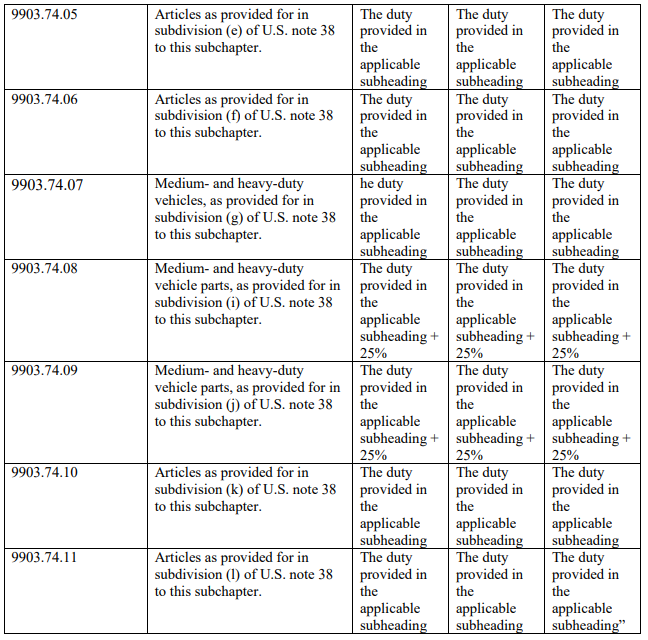
Annex I – Tariff Schedule Modifications (Effective November 1, 2025)
The proclamation modifies subchapter III of chapter 99 of the HTSUS to impose duties on medium- and heavy-duty vehicles (MHDVs), buses, and related parts, with detailed rules for eligibility, exceptions, and U.S. content. In short, Annex I operationalizes the tariff system: setting rates, defining exemptions, outlining USMCA-based reductions, and specifying which MHDVs, buses, and parts are covered. It also clarifies interaction with existing tariffs, antidumping duties, and Chapter 98 provisions, ensuring a robust enforcement framework.
Key Provisions
Flexibility and Enforcement
The Secretary of Commerce may expand the list of parts subject to tariffs and adjust duties to address evolving security risks. Imports into U.S. foreign trade zones must follow “privileged foreign status” rules, and tariff stacking adheres to prior automobile tariff programs for consistency. Adjustments may also be applied to aluminum and steel imports from USMCA partners to support U.S. production.
The administration will continuously monitor imports and advise the President on whether further actions are necessary, ensuring the program remains responsive to national security needs.
Expected Outcomes
The proclamation aims to:
Strengthen the domestic industrial base and supply chains.
Increase U.S. production, high-quality jobs, and investment.
Enhance military and logistical self-sufficiency.
Modernize and stabilize the truck and bus industries.
This move operationalizes the Section 232 findings, combining tariffs, offsets, and oversight to reduce dependence on foreign suppliers while bolstering U.S. capacity for critical vehicles and parts.
Source:


Comments