
UK Low Value Import Reforms Explained
- Annkaren Wambui

- 12 hours ago
- 5 min read
🔓 The UK Government will abolish the £135 Low Value Import relief, implementing a major customs reform impacting e-commerce, parcel operators, and international supply chains.
Summary: The UK Government has released draft legislation to remove the £135 Low Value Import (LVI) customs duty relief as part of customs modernisation reforms. These changes aim to create a fairer trading environment, enhance customs compliance, and improve customs duty collection on low-value imports. Businesses should start preparing. Importers, exporters, online marketplaces, customs intermediaries, and logistics providers will face new customs procedures, additional declaration requirements, and changes in how low-value goods enter the UK. |
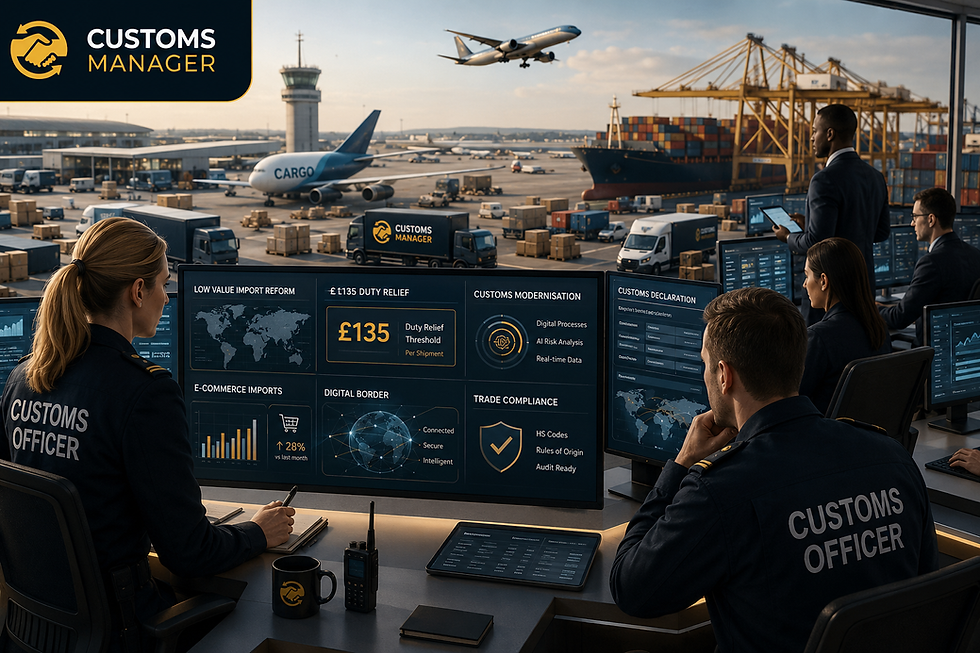
UK Government Proposes Abolition of £135 Low Value Import Duty Relief
The UK Government has published draft legislation confirming one of the most significant customs reforms affecting international trade in recent years.
As part of the Finance Bill 2026–27, HM Treasury intends to abolish the current £135 Low Value Import (LVI) customs duty relief, fundamentally changing how millions of low-value consignments are treated when entering the United Kingdom.
The reforms are designed to modernise customs procedures, improve compliance, strengthen border controls and create a more level playing field between UK retailers and overseas online sellers.
For businesses involved in international trade, the proposals represent far more than a technical customs amendment—they signal a major shift in the UK's approach to cross-border e-commerce.
Why Is the Government Changing the Rules?
When the current relief was introduced, international e-commerce represented only a fraction of today's parcel volumes.
The rapid growth of online marketplaces and cross-border fulfilment has dramatically increased the number of low-value consignments entering the UK each day.
According to HM Treasury, the current arrangements no longer reflect modern trading patterns and may create competitive disadvantages for UK retailers while limiting customs visibility over imported goods.
The proposed reforms aim to:
Improve customs compliance
Create fairer competition
Modernise customs procedures
Increase customs data quality
Support digital border initiatives
What Will Change?
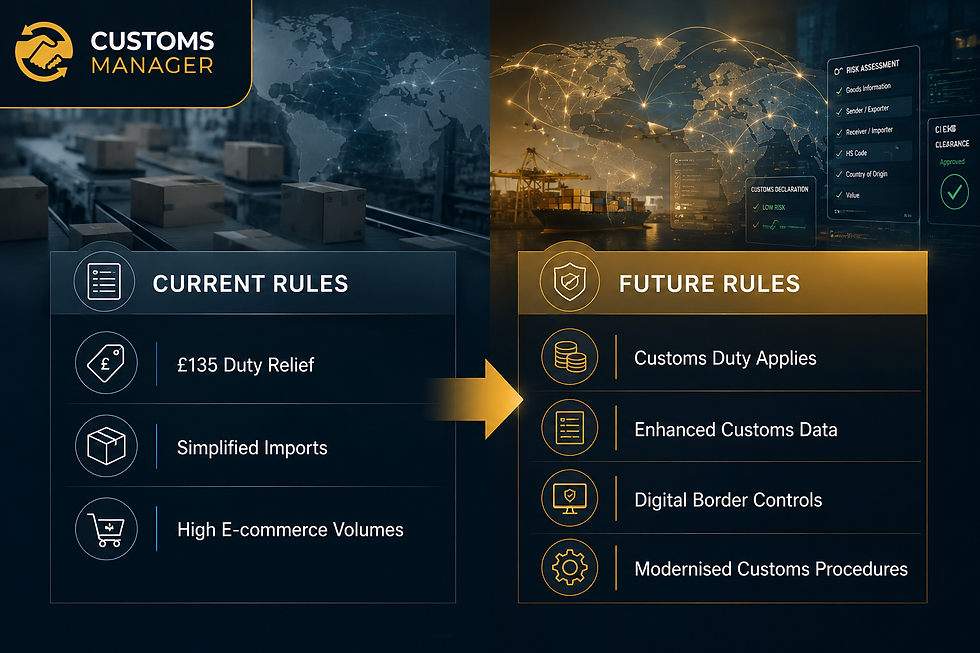
The Government proposes removing the existing £135 customs duty exemption for qualifying imports. Instead, low-value imports will become subject to customs duty through a new simplified customs framework.
Businesses should also expect:
Additional customs declaration requirements
Simplified processes for qualifying consignments
Increased digital reporting
Greater customs data transparency
New compliance responsibilities for e-commerce supply chains
Although implementation is expected by October 2028, businesses should begin preparing long before the transition date.
Who Will Be Affected?
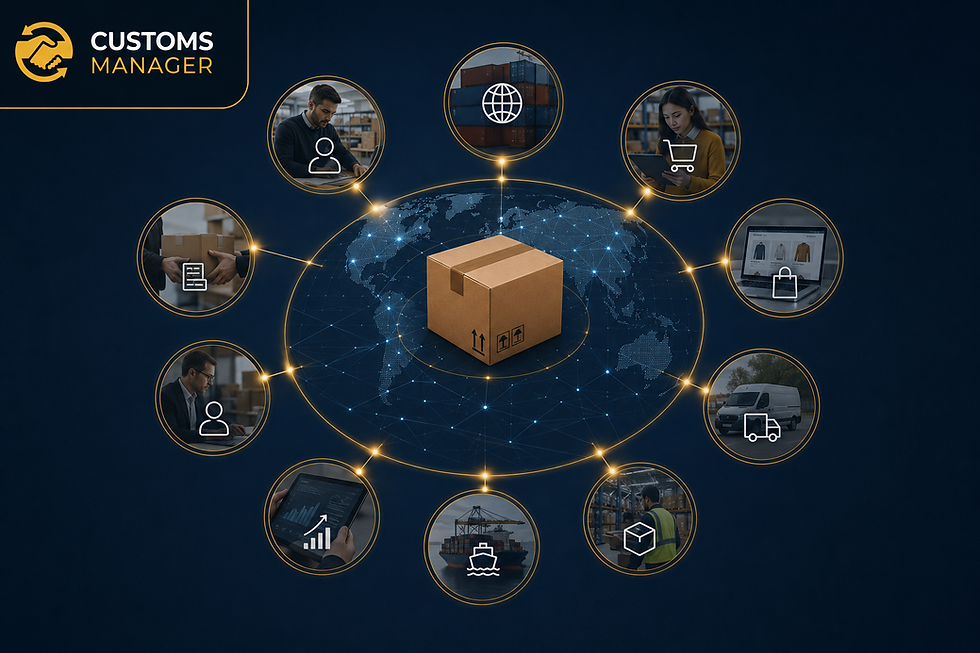
The reforms will impact almost every participant in the low-value import supply chain, including:
Importers
Exporters
Online retailers
E-commerce marketplaces
Parcel operators
Customs brokers
Freight forwarders
Logistics providers
Consumers purchasing goods from overseas
Businesses relying on high volumes of parcel imports may experience the greatest operational impact.
What Does This Mean for Customs Compliance?
Removing the customs duty relief represents more than an additional cost.
Businesses should expect customs authorities to collect more detailed import information while increasing compliance expectations.
Future customs declarations will become increasingly data-driven, requiring accurate product classifications, customs values, origin information and importer records.
For many organisations, customs compliance will become a much more integrated part of everyday supply chain management.
Preparing Your Business
Although the reforms remain under development, businesses should already begin reviewing their customs strategies.
Practical actions include:
✔ Review current low-value import volumes.
✔ Assess customs declaration processes.
✔ Engage customs brokers and logistics partners.
✔ Monitor future HMRC guidance.
✔ Evaluate pricing and landed-cost impacts.
✔ Strengthen customs governance and internal controls.
Businesses that prepare early will experience a significantly smoother transition once the reforms are implemented.
Why These Reforms Matter
Low-value imports represent one of the fastest-growing segments of international trade.
The proposed reforms demonstrate the Government's intention to modernise customs while ensuring overseas sellers compete on more equal terms with UK businesses.
As customs becomes increasingly digital, organisations investing in stronger customs compliance today will be better positioned for tomorrow's trading environment.
Key Take Away
The removal of the £135 Low Value Import relief represents one of the most important customs developments affecting UK e-commerce and international trade in recent years.
Although implementation remains some time away, businesses should use this opportunity to review customs procedures, strengthen compliance programmes and prepare for a more data-driven customs environment.
Organisations that act early will be best placed to minimise disruption, manage costs and remain compliant as the new rules are introduced.
Need Help Preparing for the New Rules?
At Customs Manager Ltd, we help businesses prepare for changing customs legislation through:
Customs Compliance Reviews
Strengthen your customs governance before new rules take effect.
Customs Strategy & Advisory
Receive expert guidance on customs reforms, e-commerce compliance and supply chain planning.
Knowledge Hub & Content Library
Access expert articles, practical guides, videos and customs resources covering international trade and customs compliance.
Actionable Trade Intelligence
Stay informed through our weekly customs intelligence covering the UK, EU, USA, export controls, sanctions, and global trade developments.

About Customs Manager’s Customs & Global Trade Intelligence Services
Our Professional Legislative Monitoring Service (PLM) is a research and curation service that monitors legislative updates from official government websites across selected jurisdictions and topics.
PRO Plan subscribers can access regular law change notifications to ensure they never miss a significant legal change on www.customsmanager.info – a website dedicated to customs & trade intelligence providing vital thought leadership development services to empower them to trade effectively, efficiently, and, of course, compliantly, across borders.
Pro Subscribers can add jurisdictions and topics for an additional charge to receive white-label intelligence services tailored to their industry. To find out more, contact us by emailing info@customsmanager.org
About Customs Manager Ltd.
We aim to empower people with import, export, and transport responsibilities with helpful advice, insightful training, relevant trade intelligence, and EU, UK, and U.S. direct and indirect customs clearance services. We devote all our passion and energy to helping businesses grow faster cross-border.
Working with us means having your own multilingual Customs Manager on standby to help you trade effectively, efficiently, and, of course, compliantly wherever you want to go. Includes Brexit & U.S. Tariff support.
Main Website: www.customsmanager.org
Dedicated Trade intelligence website: www.customsmanager.info
E-Mail: info@customsmanager.org
LinkedIn: https://www.linkedin.com/company/69768402/admin/
Free Information and Updates:
Weekly Newsletter: Subscribe Here
Weekly Videos (YouTube): Ask the Customs Manager for video messages by Arne Mielken answering your questions, insightful interviews, bite-sized info videos, and more. Subscribe for free here:
Author
Ann Karen | Head of Growth
Updated: July 2026
Related Topics
#UKCustoms #LowValueImports #TradeCompliance #CustomsCompliance #InternationalTrade #Ecommerce #SupplyChain #HMRC #ImportCompliance #CustomsManager
Disclaimer
This blog is for informational purposes only and does not constitute legal or professional advice. Please consult a customs specialist regarding your specific compliance obligations.


Comments