
Why Is the EU Expanding CBAM Beyond Steel and Aluminium?
- Annkaren Wambui

- 2 days ago
- 5 min read
🔓 Explore why the European Union is expanding CBAM to downstream products and what this means for manufacturers, importers, and supply chains.
SUMMARY: The European Union is preparing to expand the Carbon Border Adjustment Mechanism (CBAM) to cover hundreds of additional steel- and aluminium-intensive products. The move aims to close loopholes that allow businesses to avoid carbon costs by importing finished goods instead of basic materials. Manufacturers, importers, and supply chain professionals may need to prepare for a more complex carbon compliance environment. |
Why Is the EU Closing the CBAM Loophole?

Businesses may no longer be able to avoid carbon costs simply by importing finished products. The European Union introduced the Carbon Border Adjustment Mechanism to prevent carbon leakage and create a level playing field between European producers and foreign competitors.
Until now, CBAM has focused primarily on basic materials such as steel, aluminium, cement, fertilisers, electricity, and hydrogen.
However, policymakers have become increasingly concerned that manufacturers could circumvent the system by importing more processed products instead of the underlying raw materials.
Which Products Could Be Added to CBAM?
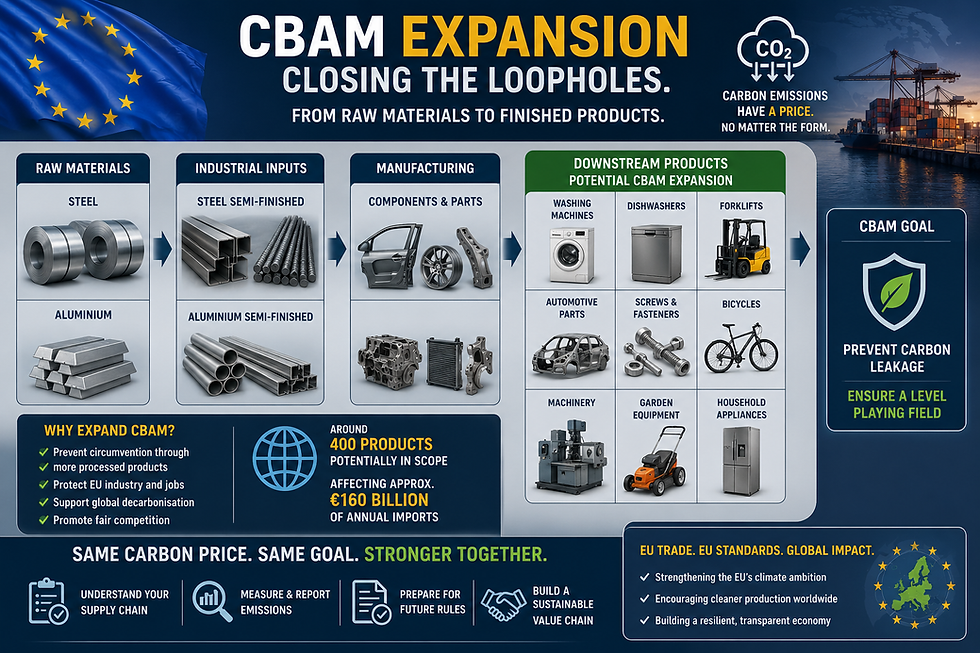
Hundreds of downstream products may eventually enter the scope of carbon border measures. The European Commission originally proposed extending CBAM to approximately 180 downstream products.
Member States have gone even further, bringing the total close to 400 products.
These may include:
► Vehicle components
► Machinery
► Washing machines
► Garden equipment
► Construction materials
► Industrial equipment
► Household appliances
► Metal components and fasteners
Together, these products represent around €160 billion of annual imports into the European Union.
Why Are Washing Machines and Car Parts Becoming a Carbon Issue?
CBAM is evolving from a raw materials mechanism into a value-chain mechanism.
European industries already pay for their carbon emissions through the EU Emissions Trading System (ETS).
Without additional measures, overseas manufacturers could gain a cost advantage by using carbon-intensive production methods while exporting finished goods to Europe.
By extending CBAM further downstream, the European Union hopes to reduce the risk of circumvention and encourage cleaner production globally.
For many businesses, this represents a significant shift.
Carbon reporting is no longer simply a problem for steel mills and aluminium producers.
It is becoming a supply chain issue.
What Could This Mean for Manufacturers and Importers?

Supply chain visibility may become increasingly important.
Businesses may need to understand:
► Bills of Materials.
► Embedded steel and aluminium content.
► Carbon footprints throughout the value chain.
► Supplier emissions data.
► Monitoring, Reporting and Verification (MRV) systems.
► Product classifications and sourcing decisions.
As CBAM expands, customs compliance and sustainability reporting are becoming increasingly interconnected.
The challenge is no longer simply understanding what a product is.
It is understanding what is inside it and how it was produced.
Could More Products Be Added In The Future?
The expansion of CBAM may not stop here.
According to the proposal, the European Commission could review additional products annually for possible inclusion.
This suggests that CBAM may continue to evolve as regulators seek to close new loopholes and maintain the effectiveness of Europe's climate policies.
Businesses should therefore avoid viewing the current scope of CBAM as fixed.
In customs and trade, temporary measures often have an interesting habit of becoming permanent.
What Does This Mean for Businesses?
Businesses should prepare for increasing carbon compliance requirements.
Manufacturers and importers may wish to:
► Review product portfolios.
► Map Bills of Materials.
► Strengthen supplier engagement.
► Improve emissions data collection.
► Assess exposure to future CBAM expansion.
► Develop long-term sustainability strategies.
Businesses that understand their supply chains and prepare early may be better positioned to manage future costs and maintain competitiveness.
Final Thoughts
The expansion of CBAM highlights a broader trend in international trade.
Compliance is moving beyond products and declarations.
Increasingly, regulators are focusing on value chains, embedded emissions, and supply chain transparency.
The key takeaway?
Supply chain intelligence matters.
Businesses that understand their products, suppliers, and carbon footprints will be better positioned to navigate the next phase of global trade.
Or, put another way:
Businesses found a loophole.
Brussels noticed.
Want to Learn More About CBAM?
Businesses wishing to understand the Carbon Border Adjustment Mechanism in greater depth can download the European Commission's official guidance for importers.
The document explains CBAM reporting requirements, emissions calculations, and importer obligations, providing practical information to help businesses prepare for an increasingly carbon-conscious trade environment.
📥 Download the Official CBAM Guidance (PDF) 👇
Sources
► European Commission – Staff Working Document on Downstream Products and Anti- Circumvention Measures
Need Help Navigating CBAM?
At Customs Manager Ltd, we help businesses navigate increasingly complex customs and trade requirements through:
Expert Consultancy & Advice
Understand how CBAM, emissions reporting, supply chain visibility, and customs compliance obligations may affect your operations.
Specialized Training
We offer live, on-demand, and in-house training covering CBAM, Rules of Origin, tariff classification, customs valuation, and global trade risk management.
Actionable Trade Intelligence
Stay ahead of customs developments through our weekly trade intelligence updates, helping businesses monitor key changes across the EU, UK, U.S., and global trade landscape.
Four essential customs intelligence updates. One trusted source for staying informed, compliant, and ahead of change.

About Customs Manager's Customs & Global Trade Intelligence Services
Our Professional Legislative Monitoring Service (PLM) monitors legislative developments and official government sources across multiple jurisdictions.
PRO subscribers can access regular law change notifications via www.customsmanager.info, ensuring they never miss a significant customs, trade, sanctions, or export control development.
Main Website: www.customsmanager.org
Dedicated Trade intelligence website: www.customsmanager.info
E-Mail: info@customsmanager.org
LinkedIn: https://www.linkedin.com/company/69768402/admin/
Free Information and Updates:
Weekly Newsletter: Subscribe Here
Weekly Videos (YouTube): Ask the Customs Manager for video messages by Arne Mielken answering your questions, insightful interviews, bite-sized info videos, and more. Subscribe for free here:
Related Topics
#CBAM #CarbonBorderAdjustmentMechanism #TradeCompliance #SupplyChain #CarbonReporting #SteelIndustry #Aluminium #Sustainability #CustomsCompliance #InternationalTrade #ImportExport #CustomsManager
Author:
Annkaren Wambui | Growth Partner at Customs Manager Ltd.
Updated: June 2026
Disclaimer
This blog is for informational purposes only and does not constitute legal or professional advice. Please consult a customs specialist regarding your specific compliance obligations.


Comments