
Will Brexit EV Tariffs Be Delayed Again?
- Annkaren Wambui

- Jun 9
- 5 min read
🔓 Explore the ongoing debate on Brexit EV Tariffs and their potential delay. Stay informed on Brexit EV Tariffs and their impact on the auto industry.
SUMMARY: European and UK automotive manufacturers are lobbying for another postponement of the stricter Rules of Origin requirements under the EU-UK Trade and Cooperation Agreement. From 1 January 2027, electric vehicles that fail to satisfy local content thresholds could face 10% tariffs. Businesses involved in automotive supply chains should closely monitor developments and assess how battery sourcing and origin requirements may affect competitiveness and market access. |
Why Are Brexit EV Tariffs Returning?

The EU-UK Trade and Cooperation Agreement currently allows electric vehicles and batteries to benefit from tariff-free trade, provided they satisfy specific Rules of Origin requirements.
Temporary easements were agreed to help manufacturers adapt while developing local battery supply chains.
However, these transitional arrangements are due to expire on 1 January 2027.
Unless further changes are agreed, electric vehicles that fail to meet the required local content thresholds could become subject to 10% tariffs when traded between the United Kingdom and the European Union.
For manufacturers already facing intense global competition, the implications could be significant.
Why Are Car Manufacturers Seeking Another Delay?

According to industry representatives, battery supply chains across Europe remain underdeveloped.
Manufacturers argue that additional time is needed to scale up battery production and reduce reliance on imported components.
Without further flexibility, some vehicles may no longer qualify for preferential treatment under the Trade and Cooperation Agreement.
Industry bodies have therefore called on the European Commission and UK Government to consider postponing the stricter requirements for a second time.
For many businesses, the issue is not simply about tariffs but about maintaining competitiveness and supporting the transition towards electric mobility.
How Do Rules of Origin Affect Electric Vehicles?

Rules of Origin determine whether products qualify for preferential tariff treatment under free trade agreements.
For electric vehicles, these requirements focus heavily on battery components and the proportion of originating content.
If the required thresholds are not met, preferential treatment may be lost and customs duties could apply.
This makes origin calculations increasingly important for manufacturers and suppliers throughout the automotive supply chain.
Businesses may need to review Bills of Materials, supplier declarations, and sourcing strategies to ensure compliance.
Why Are Battery Supply Chains So Important?
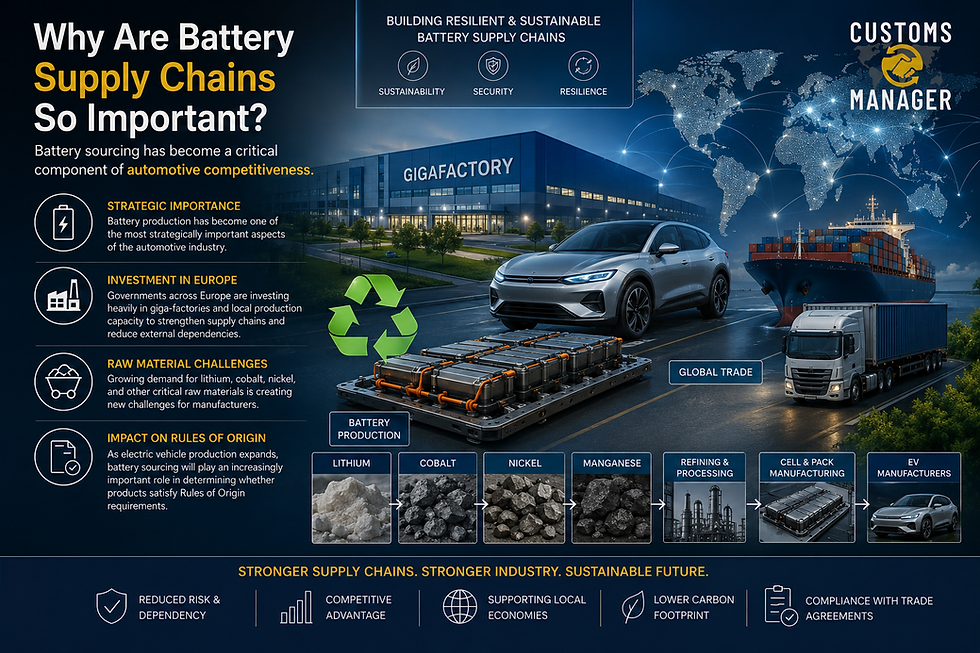
Battery production has become one of the most strategically important aspects of the automotive industry.
Governments across Europe are investing heavily in giga-factories and local production capacity in an effort to strengthen supply chains and reduce external dependencies.
At the same time, growing demand for lithium, cobalt, nickel, and other critical raw materials is creating new challenges for manufacturers. As electric vehicle production expands, battery sourcing will play an increasingly important role in determining whether products satisfy Rules of Origin requirements.
What Does This Mean for Businesses?

Regardless of whether another delay is granted, businesses should not assume that existing arrangements will remain unchanged indefinitely.
Manufacturers and suppliers may wish to:
► Review Rules of Origin requirements.
► Assess battery sourcing strategies.
► Strengthen supplier documentation.
► Improve supply chain visibility.
► Prepare for possible tariff exposure.
► Monitor future developments closely.
Businesses that prepare early may be better positioned to protect margins and maintain market access.
Final Thoughts
The debate surrounding Brexit EV tariffs highlights a broader challenge facing manufacturers across Europe and the United Kingdom.
While Rules of Origin were designed to encourage local battery production and strengthen regional supply chains, many businesses continue to face significant sourcing challenges.
The key takeaway?
Supply chain visibility matters.
Businesses that understand their supply chains, verify origin requirements, and proactively prepare for changing customs rules will be better positioned to protect competitiveness and reduce tariff risks.
Want to Read the Full Guidance?
The EU-UK Trade and Cooperation Agreement and accompanying Rules of Origin guidance provide detailed information on the requirements that determine whether electric vehicles and batteries qualify for tariff-free treatment between the United Kingdom and the European Union.
Businesses wishing to understand the requirements in greater depth can download the official guidance below and assess how future changes may affect battery sourcing, supply chains, and exposure to potential Brexit EV tariffs.
Sources
Need Help Navigating Rules of Origin?
At Customs Manager Ltd, we help businesses navigate increasingly complex customs and trade requirements through:
Expert Consultancy & Advice
Understand how Rules of Origin, battery sourcing, supply chain decisions, and customs compliance obligations may affect your operations.
Specialized Training
We offer live, on-demand, and in-house training covering Rules of Origin, tariff classification, customs valuation, electric vehicle supply chains, and global trade risk management.
Actionable Trade Intelligence
Stay ahead of customs developments through our weekly trade intelligence updates, helping businesses monitor key changes across the EU, UK, U.S., and global trade landscape

About Customs Manager’s Customs & Global Trade Intelligence Services
Our Professional Legislative Monitoring Service (PLM) is a research and curation service that monitors legislative updates from official government websites across selected jurisdictions and topics.
PRO Plan subscribers can access regular law change notifications to ensure they never miss a significant legal change on www.customsmanager.info – a website dedicated to customs & trade intelligence providing vital thought leadership development services to empower them to trade effectively, efficiently, and, of course, compliantly, across borders.
Pro Subscribers can add jurisdictions and topics for an additional charge to receive white-label intelligence services tailored to their industry. To find out more, contact us by emailing info@customsmanager.org
About Customs Manager Ltd.
We aim to empower people with import, export, and transport responsibilities with helpful advice, insightful training, relevant trade intelligence, and EU, UK, and U.S. direct and indirect customs clearance services. We devote all our passion and energy to helping businesses grow faster cross-border.
Working with us means having your own multilingual Customs Manager on standby to help you trade effectively, efficiently, and, of course, compliantly wherever you want to go. Includes Brexit & U.S. Tariff support.
Main Website: www.customsmanager.org
Dedicated Trade intelligence website: www.customsmanager.info
E-Mail: info@customsmanager.org
LinkedIn: https://www.linkedin.com/company/69768402/admin/
Free Information and Updates:
Weekly Newsletter: Subscribe Here
Weekly Videos (YouTube): Ask the Customs Manager for video messages by Arne Mielken answering your questions, insightful interviews, bite-sized info videos, and more. Subscribe for free here:
Related Topics
#BrexitEVTariffs #RulesOfOrigin #ElectricVehicles #AutomotiveIndustry #SupplyChain #TradeCompliance #CustomsCompliance #BatterySupplyChains #InternationalTrade
Author:
Annkaren Wambui | Growth Partner at Customs Manager Ltd.
Updated: June 2026
Disclaimer
This blog is for informational purposes only and does not constitute legal or professional advice. Please consult a customs specialist regarding your specific compliance obligations.


Comments