
Gibraltar's New Post-Brexit Customs Framework
- Annkaren Wambui

- a few seconds ago
- 7 min read
🔓 Discover what the new UK-EU agreement means for border controls, customs procedures, import taxes and businesses trading through Gibraltar.
Summary: The United Kingdom, the European Union, and Spain have established a significant post-Brexit framework that alters the movement of people and goods between Gibraltar and the EU, introducing a bespoke customs union, new customs procedures, Spanish-operated Schengen border checks, and a Transaction Tax to replace Gibraltar's current import duty regime. This agreement marks a major change for importers, exporters, customs brokers, and supply chain professionals, prompting businesses to evaluate the impact of these new customs arrangements and taxation on their supply chains, import costs, and compliance obligations. |

Gibraltar Enters a New Customs Era
Nearly a decade after the United Kingdom voted to leave the European Union, Gibraltar's future trading relationship with Europe is finally becoming clearer.
Following years of negotiations between the UK, Spain and the European Union, a new post-Brexit agreement establishes an entirely new framework governing customs, border management and the movement of people and goods. Rather than creating a hard external border between Gibraltar and Spain, the agreement seeks to maintain fluid movement across one of Europe's busiest frontier crossings while introducing new customs and immigration controls elsewhere.
For businesses operating in Gibraltar—or trading through it—this represents a major operational shift that extends far beyond immigration.
Customs procedures, import taxation and regulatory alignment will all change under the new framework.
Why Gibraltar Matters for International Trade

Although geographically small, Gibraltar occupies a strategically important position at the entrance to the Mediterranean. Thousands of workers cross the frontier every day, while businesses rely on uninterrupted movement of goods between Gibraltar, Spain and the wider European Union.
Following Brexit, uncertainty surrounding Gibraltar's relationship with the EU created concerns for:
Importers
Exporters
Logistics providers
Retailers
Manufacturers
Tourism operators
Cross-border workers
Without a long-term agreement, the introduction of full Schengen border controls threatened significant delays that could have disrupted both trade and Gibraltar's economy.
The new agreement seeks to avoid those risks by relocating many border formalities away from the land frontier.
New Border Controls Without a Land Border
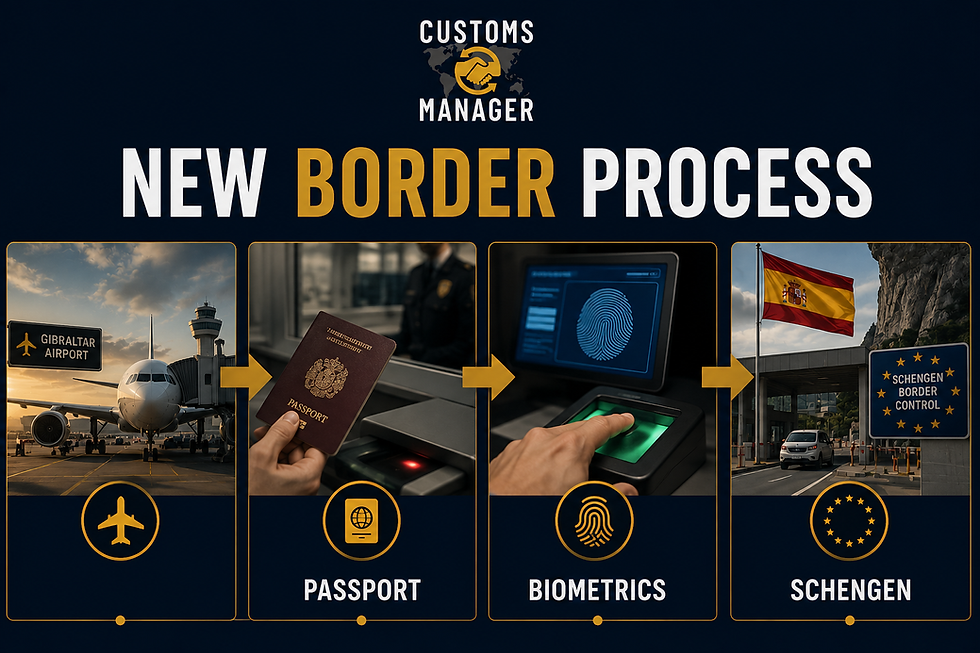
One of the most significant features of the agreement is how border controls will operate.
Instead of introducing routine passport checks at Gibraltar's land border with Spain, immigration checks for travellers arriving from outside the Schengen Area will take place at Gibraltar's airport and port.
Travellers will first undergo Gibraltar's own immigration checks before Spanish border officials carry out Schengen Entry/Exit System (EES) procedures on behalf of the European Union.
These controls will include:
Passport verification
Biometric fingerprint collection
Facial image capture
Entry and exit registration
This approach mirrors existing arrangements at London's St Pancras International station, where British and French border authorities conduct exit and entry checks before passengers board Eurostar services.
For travellers, this means that crossing the land frontier between Gibraltar and Spain should become significantly smoother once the agreement is fully implemented. The framework provides for Spanish authorities to conduct a second line of Schengen border controls at Gibraltar's airport and port while allowing the land border to operate with much greater fluidity.
Spanish Border Officers Will Perform Schengen Checks
The agreement authorises Spanish border officials to carry out Schengen immigration controls within Gibraltar's airport and port. During legitimate border control activities they will possess powers normally exercised by Schengen authorities, including identity verification and, where legally justified, additional enforcement actions.
Importantly, these powers relate to Schengen border management rather than any transfer of sovereignty.
Both the UK and Gibraltar governments have repeatedly stated that the agreement does not alter Gibraltar's constitutional status as a British Overseas Territory.
Instead, it creates a practical operational arrangement designed to facilitate free movement while satisfying European border security requirements.
For customs professionals, separating questions of sovereignty from operational customs procedures is important. The agreement is fundamentally about making trade and travel more efficient while maintaining regulatory compliance.
What Businesses Should Take Away
Even before implementation is complete, businesses should begin asking important operational questions:
Will current customs procedures require updating?
Are existing supply chains prepared for new customs processes?
Will documentation need revision?
How will border formalities affect logistics planning?
Are customs software systems ready for the new requirements?
Businesses that prepare early will be far better positioned when the agreement enters into force.
A Bespoke Customs Union: What Makes It Different?
One of the most significant elements of the agreement is the creation of a bespoke customs union between Gibraltar and the European Union.
Unlike a full EU Member State, Gibraltar will not formally join the EU Customs Union. Instead, it will operate under a tailored customs arrangement designed specifically for Gibraltar's unique geographical and economic circumstances.
For businesses, the practical outcome is that Gibraltar will align many of its customs rules and import duty rates with those applied across the European Union.
The objective is clear:
Eliminate unnecessary customs barriers.
Facilitate smoother movement of goods.
Reduce delays at the Gibraltar–Spain frontier.
Improve supply chain efficiency.
This bespoke arrangement represents one of the final pieces of the post-Brexit customs framework and reflects years of negotiations between the UK, Gibraltar, Spain and the European Union.
A New Transaction Tax Replaces Import Duties
One of the biggest changes for businesses concerns taxation.
Gibraltar has traditionally operated with:
No VAT
Low import duties
A highly competitive indirect tax system
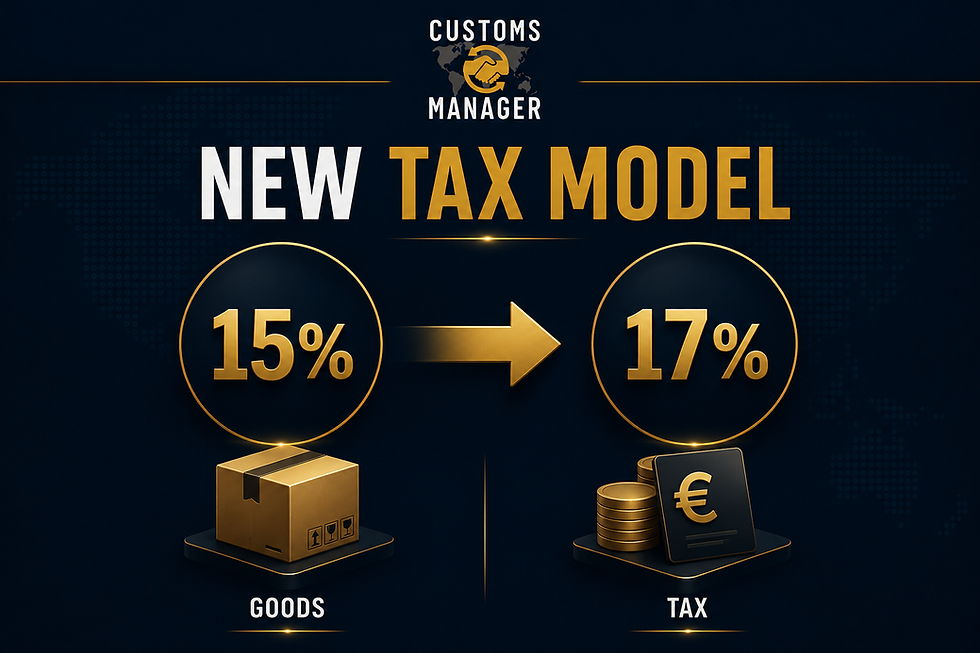
Under the new agreement, Gibraltar will retain its zero-VAT regime, but introduce a new Transaction Tax on goods imported into or produced within Gibraltar for sale.
The tax will begin at 15%, before increasing to 17% by 2028.
For many businesses, this means pricing models, procurement decisions and inventory planning may require review. Although some products may become more expensive, Gibraltar's government believes easier border movements and increased visitor numbers will offset some of these additional costs. The agreement introduces a new Transaction Tax while retaining Gibraltar's zero-VAT model and aligning customs arrangements more closely with the EU.
Customs Clearance Will Change
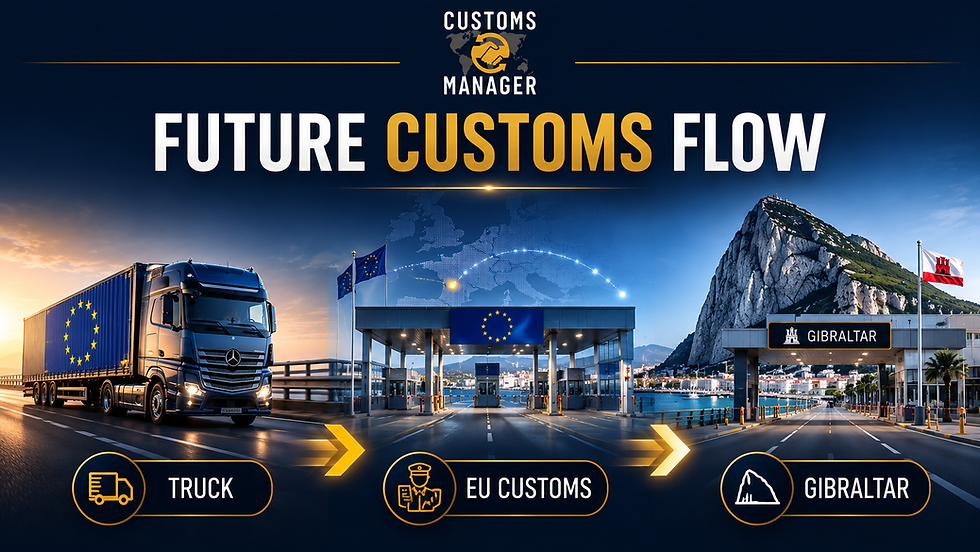
The agreement also modernises customs clearance procedures.
Rather than carrying out routine customs controls at the land border, the majority of goods entering Gibraltar will be cleared through designated EU customs offices located in Spain.
This approach is designed to minimise congestion at the frontier while maintaining appropriate customs supervision.
For customs brokers, freight forwarders and logistics providers, this will require close attention to:
Customs declarations
Import documentation
Clearance procedures
Duty calculations
Digital customs systems
Businesses should review existing customs processes well before implementation to ensure operational readiness.
What Does This Mean for Businesses?

Although the agreement simplifies cross-border movement, it also introduces new compliance responsibilities.
Businesses trading with Gibraltar should begin reviewing:
Supply Chains
Will sourcing strategies remain commercially competitive under the revised customs and tax arrangements?
Customs Classification
Will existing commodity classifications remain appropriate under the new framework?
Customs Valuation
Will Transaction Tax alter customs value calculations or pricing strategies?
Documentation
Are customs declarations, commercial invoices and supporting documents aligned with future requirements?
Customs Systems
Can internal customs software accommodate revised customs procedures and tax treatments? Businesses that prepare early are likely to experience a smoother transition than those waiting until implementation.
Looking Ahead
The Gibraltar agreement represents far more than a political milestone.
For customs professionals, it marks the beginning of a new operational framework governing border management, customs procedures and indirect taxation.
While the agreement removes uncertainty surrounding Gibraltar's future relationship with the European Union, businesses should not assume implementation will be automatic.
Systems, procedures, customs documentation and supply chain planning should all be reviewed before the new arrangements become fully operational.
Companies that prepare now will be best placed to benefit from improved border efficiency while maintaining full customs compliance.
Sources
UK Government: Official Gibraltar Agreement documentation.
European Commission: EU–UK Gibraltar negotiations.
Government of Gibraltar: Official announcements on customs arrangements and Transaction Tax.
Need Help Preparing for Gibraltar's New Customs Arrangements?
At Customs Manager Ltd, we help businesses navigate evolving customs legislation and international trade requirements through:
Expert Consultancy & Advice
Assess how Gibraltar's new customs framework may affect your imports, exports, customs procedures and supply chain strategy.
Specialized Training
We provide practical training covering:
EU Customs
UK Customs
Rules of Origin
Customs Valuation
Tariff Classification
Special Procedures
Customs Compliance
Trade Intelligence
Stay informed through our weekly customs intelligence publications, Knowledge Hub articles and expert analysis.
Customs Compliance Support
Strengthen customs governance, documentation, internal controls and customs procedures before regulatory changes take effect.
Actionable Trade Intelligence
Stay informed through our weekly customs intelligence covering the UK, EU, USA, export controls, sanctions, and global trade developments.

About Customs Manager’s Customs & Global Trade Intelligence Services
Our Professional Legislative Monitoring Service (PLM) is a research and curation service that monitors legislative updates from official government websites across selected jurisdictions and topics.
PRO Plan subscribers can access regular law change notifications to ensure they never miss a significant legal change on www.customsmanager.info – a website dedicated to customs & trade intelligence providing vital thought leadership development services to empower them to trade effectively, efficiently, and, of course, compliantly, across borders.
Pro Subscribers can add jurisdictions and topics for an additional charge to receive white-label intelligence services tailored to their industry. To find out more, contact us by emailing info@customsmanager.org
About Customs Manager Ltd.
We aim to empower people with import, export, and transport responsibilities with helpful advice, insightful training, relevant trade intelligence, and EU, UK, and U.S. direct and indirect customs clearance services. We devote all our passion and energy to helping businesses grow faster cross-border.
Working with us means having your own multilingual Customs Manager on standby to help you trade effectively, efficiently, and, of course, compliantly wherever you want to go. Includes Brexit & U.S. Tariff support.
Main Website: www.customsmanager.org
Dedicated Trade intelligence website: www.customsmanager.info
E-Mail: info@customsmanager.org
LinkedIn: https://www.linkedin.com/company/69768402/admin/
Free Information and Updates:
Weekly Newsletter: Subscribe Here
Weekly Videos (YouTube): Ask the Customs Manager for video messages by Arne Mielken answering your questions, insightful interviews, bite-sized info videos, and more. Subscribe for free here:
Author
Ann Karen | Head of Growth
Updated: July 2026
Related Topics
#Gibraltar #Brexit #EUCustoms #UKCustoms #TradeCompliance #CustomsCompliance #ImportExport #SupplyChain #CustomsUnion #Schengen #TransactionTax #BorderControls #InternationalTrade #TradeIntelligence #CustomsManager
Disclaimer
This article is provided for general informational purposes only and does not constitute legal, customs or tax advice. Businesses should seek professional advice based on their individual trading arrangements and compliance obligations.


Comments