
Global Trade Compliance Through 2030
- Annkaren Wambui

- Jun 8
- 5 min read
🔓Explore 'Global Trade Compliance Through 2030' insights with Douglas McKay. Discover strategies for proactive risk management in global trade compliance.
Summary: In this interview, Douglas McKay discusses the evolution of global trade compliance, the growing importance of proactive risk management, the role of AI and automation, and the challenges businesses may face through 2030. The discussion provides practical insights for customs professionals, compliance teams, and business leaders seeking to navigate an increasingly fragmented global trade environment. |
How Has Global Trade Compliance Changed?

Global trade compliance has evolved significantly over the past several decades.
Drawing on his experience across both government and the private sector, Douglas McKay explained how customs and trade compliance have become increasingly interconnected with broader business strategy. Companies are no longer dealing solely with customs declarations and tariffs. Today's compliance landscape includes sanctions, export controls, ESG requirements, ethical sourcing, and supply chain transparency.
According to Douglas, businesses are increasingly required to adopt a holistic approach to trade compliance rather than treating customs as an isolated function.
This shift is transforming compliance from an operational necessity into a strategic business discipline.
What Are the Biggest Compliance Risks Facing Businesses?

One of the key themes discussed during the interview was risk management.
Douglas highlighted that many organisations continue to underestimate the importance of proactive compliance. In many cases, businesses only react when problems arise, increasing the likelihood of customs penalties, sanctions violations, reputational damage, and supply chain disruptions.
Among the most common blind spots are:
► Weak internal controls.
► Poor supplier visibility.
► Insufficient documentation.
► Inadequate sanctions screening.
► Lack of cross-functional coordination.
These risks can create significant financial and legal exposure if not properly managed.
Businesses that invest in governance and compliance frameworks are generally better positioned to respond to regulatory changes and enforcement actions.
Can AI Transform Customs and Trade Compliance?

Artificial intelligence and automation are already changing the way businesses manage customs and trade processes.
Douglas noted that technology can provide significant efficiencies, particularly in areas such as classification, screening, and data analysis. However, he emphasised that technology alone cannot replace human expertise.
Government investigations, customs audits, and complex compliance decisions still require judgement and interpretation.
The future is likely to involve a combination of AI-driven tools and experienced professionals working together. Rather than replacing trade professionals, artificial intelligence may allow them to focus on higher-value activities and strategic decision-making.
How Should Companies Prepare for Global Trade Compliance 2030?

The interview also explored the future of global trade.
Douglas believes businesses will need to adapt to a world increasingly characterised by:
► Geopolitical fragmentation.
► Friend-shoring.
► Ethical sourcing requirements.
► Supply chain resilience.
► Greater regulatory scrutiny.
► Expanding sanctions and export controls.
Companies that continue to rely on reactive approaches may struggle to remain competitive.
Success through 2030 will depend on stronger supplier relationships, better data, improved visibility, and a willingness to embrace change.
Strategic thinking will become increasingly important as global supply chains continue to evolve.
Why Proactive Compliance Matters
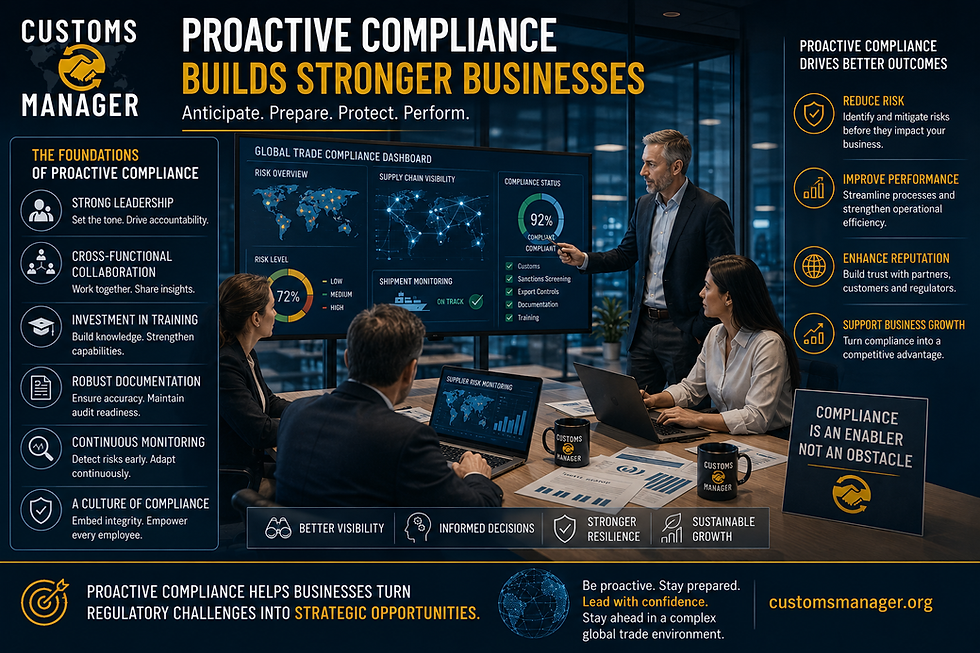
One of Douglas McKay's strongest messages was that businesses should move away from reactive crisis management.
Proactive compliance allows organisations to identify risks before they become costly problems.
This requires:
► Strong leadership.
► Cross-functional collaboration.
► Investment in training.
► Robust documentation.
► Continuous monitoring.
► A culture of compliance.
According to Douglas, organisations that strengthen these foundations will be better equipped to manage uncertainty and protect their competitive position.
In an era of increasing complexity, compliance should be viewed as an enabler of business growth rather than simply a regulatory obligation.
🎥 The Future of Global Trade Compliance: Insights from Douglas McKay
In this expert discussion hosted by Arne Mielken, Douglas McKay shares valuable perspectives on customs compliance, sanctions, AI, risk management, and the future of international trade.
Watch the full interview below to gain practical insights into the challenges and opportunities shaping global trade through 2030.
Final Thoughts
Global trade compliance is undergoing one of the most significant transformations in decades.
As Douglas McKay explained, customs compliance is no longer limited to tariffs and declarations. Businesses must now navigate sanctions, export controls, ethical sourcing requirements, geopolitical tensions, and rapidly evolving technologies.
Success will increasingly depend on an organisation's ability to strengthen governance, improve supply chain visibility, and adopt a proactive approach to risk management.
The key takeaway?
Preparation matters.
Businesses that invest in people, technology, and strong compliance frameworks today will be best positioned to navigate uncertainty and remain competitive through 2030.
Official Source
► Customs Manager YouTube Channel : Watch this and get more informed in other related topics
Need Help Strengthening Global Trade Compliance?
At Customs Manager Ltd, we help businesses navigate increasingly complex customs, sanctions, and trade requirements through:
Expert Consultancy & Advice
Understand how customs compliance, sanctions, export controls, and supply chain risks may affect your business and international trade operations.
Specialized Training
We offer live, on-demand, and in-house training covering customs compliance, export controls, sanctions, tariff classification, Rules of Origin, and global trade risk management.
Trade Compliance Support
We help businesses strengthen governance, improve documentation, enhance supply chain visibility, and prepare for evolving U.S., UK, and EU trade requirements.
Actionable Trade Intelligence
Stay ahead of customs developments through our weekly trade intelligence updates, helping businesses monitor key changes across the EU, UK, U.S., and global trade landscape

About Customs Manager’s Customs & Global Trade Intelligence Services
Our Professional Legislative Monitoring Service (PLM) is a research and curation service that monitors legislative updates from official government websites across selected jurisdictions and topics.
PRO Plan subscribers can access regular law change notifications to ensure they never miss a significant legal change on www.customsmanager.info – a website dedicated to customs & trade intelligence providing vital thought leadership development services to empower them to trade effectively, efficiently, and, of course, compliantly, across borders.
Pro Subscribers can add jurisdictions and topics for an additional charge to receive white-label intelligence services tailored to their industry. To find out more, contact us by emailing info@customsmanager.org
About Customs Manager Ltd.
We aim to empower people with import, export, and transport responsibilities with helpful advice, insightful training, relevant trade intelligence, and EU, UK, and U.S. direct and indirect customs clearance services. We devote all our passion and energy to helping businesses grow faster cross-border.
Working with us means having your own multilingual Customs Manager on standby to help you trade effectively, efficiently, and, of course, compliantly wherever you want to go. Includes Brexit & U.S. Tariff support.
Main Website: www.customsmanager.org
Dedicated Trade intelligence website: www.customsmanager.info
E-Mail: info@customsmanager.org
LinkedIn: https://www.linkedin.com/company/69768402/admin/
Free Information and Updates:
Weekly Newsletter: Subscribe Here
Weekly Videos (YouTube): Ask the Customs Manager for video messages by Arne Mielken answering your questions, insightful interviews, bite-sized info videos, and more. Subscribe for free here!
Interested in Sharing Your Expertise? Are you a customs, trade, sanctions, export controls, supply chain, or logistics professional with valuable insights to share? Customs Manager Ltd regularly features expert interviews and thought leadership discussions. We would be delighted to hear from individuals interested in contributing to the conversation and helping businesses navigate an increasingly complex global trade environment.
Related Topics
#GlobalTradeCompliance #CustomsCompliance #TradeCompliance #ArtificialIntelligence #Sanctions #ExportControls #SupplyChain #RiskManagement #InternationalTrade
Author:
Annkaren Wambui | Growth Partner at Customs Manager Ltd.
Updated: June 2026
Disclaimer
This blog is for informational purposes only and does not constitute legal or professional advice. Please consult a customs specialist regarding your specific compliance obligations.



Comments