Search Results
1627 results found with an empty search
- Download offical CDS Guidance from HMRC here
Download official guidance from HMRC on the move to CDS, CDS Trader's Checklist, and Import Guide using CDS, Export Guide using CDS, Movement Reference Number Guide using CDS, CDS Finance Options. CDS Trader's Checklist Import Guide using CDS Export Guide using CDS Movement Reference Number Guide using CDS CDS Finance Options
- OMG! Single Administrative Document - SAD: How do I complete it?
Every customs manager should know how to complete a customs entry. We explain how. The Single Administrative Document (SAD) is a customs declaration form used in the United Kingdom, the European Union, Switzerland, Norway, Iceland, Turkey, the Republic of North Macedonia, and Serbia. It is constructed of a collection of eight duplicates, each with a separate purpose, in paper form. It is also used in the United Kingdom until 2022. It is gradually being replaced by the UCC Data set which replaces the paper copy with electronic data elements. Download the C88 Using a single document saves administrative effort while increasing standards and harmonisation of trade data. Where is the Single Administrative Document used? The single administrative document is used for international commerce and the transportation of foreign products inside a country/jurisdiction. Since the 1987 Convention on the Simplification of Formalities in Goods Trade, it has also applied to the territories of EFTA countries (Switzerland, Norway, and Iceland), Turkey (since 1 December 2012), and the Republic of North Macedonia (since 1 July 2015), as well as trade between these countries and the EU. Procedures covered The document covers the placement of any goods under any customs procedure such as export, free circulation, transit (where the New Computerised Transit System was not used), warehouses, temporary admission, inward and outward processing, etc. It has more than 50 boxes, and they need to be completed on a step by step basis. What do I need to complete the SAD? This will depend very much on what you want to do, the type of movement. The option are: A: Export/Dispatch B: Customs warehousing procedure in order to obtain payment of special export refunds prior to exportation or manufacturing under customs supervision and under customs control prior to exportation and payment of export refunds C: Re-export after a special procedure other than the customs warehousing procedure D: Re-export after customs warehousing E: Outward processing F: Transit G: Community status of Union goods H: Release for free circulation I: Placing of goods inward processing or temporary importation J: Placing under a customs warehouses. When is information Mandatory, when not? There are only three options: A: Mandatory: Particulars required by every Member State (A = Absolutely necessary) B: Optional for the Member States: Particulars which the Member States may decide to waive (B = Both possible) C: Optional for operators: Particulars which operators may decide to supply but which cannot be demanded by the Member States (C = Choice) The SAD Matrix The EU Commission has now published a simple Matrix that explains when a box needs to be completed and when not. There are also notes to read for completion of the SAD In this combination, it is easy to understand when a data element is required and when not. Join our Training to find out more Or study ON DEMAND, anywhere and anytime (+live support and declaration of completion) Where to find more help and support For online support, join our educational live webinars, subscribe to insightful short Twitter updates and informative YouTube videos, and stop by at our expert blog page, updated weekly: https://www.customsmanager.org/customs-global-trade-blog Join us on Linked In, too: www.linkedin.com/company/customs-manager-ltd We also offer a resources hub that covers a lot of topics, videocasts and step by steps guidance: https://www.customsmanager.org/ -> Resources There are regular customs and global trade update sessions to discuss what is coming up: https://www.customsmanager.org/customs-and-global-trade-update oin our wide range of LIVE or online training courses on the customs and global trade topics that matter to you Subscribe to our free newsletter to never miss an important update on our social media channels and expert blogs and get a round-up on all the important changes, law updates and guidance modifications for the EU and the UK). You can also call our helpline on 079146450183. The first call is free, after this, we charge a moderate fee to get instant expert support. You can access it at https://www.customsmanager.org/expert-helpline-blog-training-exclusive-briefings If you know of a business that would also find e-mails or customs and global trade blog entries helpful, please forward it on, or suggest they register to receive them directly to their inbox register to get these updates directly to their inbox. About Customs Manager Ltd. Working with us means having a Customs Advisor, Global Trade Expert and Export Controls Consultant, on speed-dial. If you are looking for a customs consultant UK and EU, let us help you trade effectively, efficiently and, of course, compliantly, wherever you want to go in the world. Need to stay up-to-date with changing customs and global trade rules? We monitor legislation so our clients don't have to. Learn about all changes in our fresh expert blog, join exclusive briefings and ask any questions 24/7 through to the VIP hotline. Or sign up to our no-charge, insightful newsletter. Entrust us with your training needs and help us to upskill you and your teams in English, German, French and Spanish. We offer pubic and private live, in-house and on-demand (study from anywhere and anytime) courses. To complete our support for globally trading businesses, we are also a UK Customs Broker. We act as a customs clearance agent on behalf of many EU and UK businesses, assisting with customs documentation and all other formalities to ensure the customs clearance of our goods. Whether you’re seeking a long-term partner to look after your customs clearance or require support for a one-off shipment, please don’t hesitate to get in touch to discuss your requirements.
- Classification challenge: Can you customs classify this shower bath ?
Customs classification can be challenging. Try your luck with our guided classification challenge and compare your results with the official solution Every once in a while, the EU issues customs classification decisions. Just like on this product. We have based our analysis on the analysis of the EU. So, when we present you with the solution, you know that we are totally aligned with the EU decision-makers and EU Customs authorities. This is why they are helpful for the trade community in creating a best practice classification argumentation and checking if you had reached the same commodity code. This is why we run these classification quizzes and talk our members through difficult cases. Together we can crack customs classification. OK, so you are ready to try your skills as a customs classifier of this shower-bath in the form of a flat tray? Great, before we start, let's remind ourselves of some top tips. Solid customs classification advice. Thank you! – Jane Williams, Customs Manager Ltd, Logistics company Customs classification is a journey of discovery. Start with answering these fundamental questions: What is the product that I am looking at? What are the necessary characteristics that I need to know about? What is the product used for? What is the commercial description vs. what it actually is? What about some technical features, length, thickness etc? We, as customs consultants EU and UK, have found in our years of classification experience that starting with the right description of the product has really helped with the classification of the product. Step 1: Nail the Description So we know that the EU has classified a shower-bath. What are the characteristics? It has the form of a flat tray, made out of a mixture of minerals and plastics and a white outer plastic coating. The product is by weight composed of the following: 65 % calcium carbonate; 28 % polyester resin; 5 % silicon dioxide; 2 % polyester ‘gel-coat’ (outer surface). The mineral components (calcium carbonate and silicon dioxide) are made out of marble chips, quartz or finely crushed granite. The production process involves first mixing the mineral component with plastic material (polyester resin). That mixture is then poured into a mould, which is lined with the polyester ‘gel-coat’, and the polyester resin is finally cured. Step 2: Build your argument, grounded in law Time to make our case Start with a section. Which one does this product fall into? Look at the GIR/GRIs and think about which ones could apply in this case? 1 & 6 is a given, but what about 3? Get your support tools ready. Have you got the Section & Chapter notes handy? Have you got access to the national explanatory notes of your country? What about the WCO classification explanatory notes? What about BTI? Case Law? Next, consider GIR 1 and find possible competing headings and try to unravel them with careful consideration of the section and heading notes. Use all the tools, including exclusions and exceptions, to support your case. Consider any other GIR rule you think is appropriate here Look at specific rules of your national tariff, like additional notes and subheading rules for numberings past 6 digits. Draft and fine-tune your justification and conclude by determining the article. How should a justification look, sound and feel There is no fixed rule, but it should clearly answer the question: Why is this code correct and give reasons backed up by the rules of classification. The geekier the better. Here is an example: Classification is determined by general rules X and X for the interpretation of the Harmonised System of Classification as published by the WCO, version of year 20XX, and (insert name of national tariff). We considered the following Notes and wordings of HS/commodity codes: note XX and xx to Section XX Wording of HS codes XXXX, XXXX National Tariff commodity codes: XXXX XXXX The articles are produced in/by .... (see note XX to Section XX). Taking into account their xxx character the articles are to be considered as xxx. In addition, note xxx to Section xxx classifies Product A like Product B in that section. Classification under heading XXXX is excluded, because (see also the Harmonized System Explanatory Note to heading XXXX (X) and the Explanatory note to the National Tariff XXXX ). Consequently, the articles are to be classified under National Code XXXX XX XXas a xxx Now it is up to you :-) Can you try to find the 6-digit code for the WCO and the eight-digit code for the EU (or your country?) YOUR ANSWER IS __ __ __ __ __ __ __ __ Solution Our answer is published in a subsequent post, with detailed explanations. Access it here Help is here If you get stuck, please reach out to us in the chat. We are always happy to assist you. Good luck! While you are here, check out these resources: An online library packed with classification tips, tricks, videos and quizzes. On-Demand Classification Training (study anywhere and anytime) All classification tools, per chapter in one place LIVE Customs classification training
- Classification challenge solution: This is how you customs classify this shower-bath
Customs classification can be challenging. So here is the solution to our challenge. What was the product CN Code you came up with? To recall, apart from this picture, this is what we know about the product: It has the form of a flat tray, made out of a mixture of minerals and plastics and a white outer plastic coating. The product is by weight composed of the following: 65 % calcium carbonate; 28 % polyester resin; 5 % silicon dioxide; 2 % polyester ‘gel-coat’ (outer surface). The mineral components (calcium carbonate and silicon dioxide) are made out of marble chips, quartz or finely crushed granite. The production process involves first mixing the mineral component with plastic material (polyester resin). That mixture is then poured into a mould, which is lined with the polyester ‘gel-coat’, and the polyester resin is finally cured. This is our justification. Did you get to the same results? As you know, there is no fixed rule, but any justification should clearly answer the question: Why is this code correct and give reasons backed up by the rules of classification? If questioned by the authorities, what argument are you going to give? Here is what we suggest: For the interpretation of the EU Combined Nomenclature and the phrasing of CN codes 3922 and 3922 10 00, we have applied the general interpretative rules 1, 3 (b), and 6. The product is not a natural stone replica, since the plastic covering covers the useable surface. As a result, it cannot be classified as a piece of artificial stone under topic 6810. (see also the Harmonized System Explanatory Notes to heading 6810 , third paragraph). In terms of product utilisation, the plastic material is the most significant component. It provides the shower tray with its important characteristics of tensile strength, chemical resistance, and water impermeability. The minerals in the mix act as a filler. As a result, the product will be classed as a shower-bath of plastics under CN code 3922 10 00. Help is here If you get stuck, please reach out to us in the chat. We are always happy to assist you. Good luck! Review the EU Decision here: While you are here, check out these resources: An online library packed with classification tips, tricks, videos and quizzes. On-Demand Classification Training (study anywhere and anytime) All classification tools, per chapter in one place LIVE Customs classification training
- Classification challenge: Can you customs classify these hairbands?
Customs classification can be challenging. Try your luck with our guided classification challenge and compare your results with the official solution OK, so you are ready to try your skills as a customs classifier of these hairbands. Great, before we start, let's remind us of some top tips. Solid customs classification advice. Thank you! – Jane Williams, Customs Manager Ltd, Logistics company Customs classification is a journey of discovery. Start with answering these fundamental questions: What is the product that I am looking at? What are the necessary characteristics that I need to know about? What is the product used for? What is the commercial description vs. what it actually is? What about some technical features, length, thickness etc? We, as customs consultants EU and UK, have found in our years of classification experience that starting with the right description of the product has really helped with the classification of the product. Step 1: Nail the Description Here is what we know about this product when looking at the picture and measuring it. It is a articles consisting of a tubular knitted, elasticated fabric It has synthetic fibres combined with a rubber thread It has the of loops with a diameter of approximately 4,5 cm and a width of approximately 2 cm (when unrolled). The articles are knitted in a tubular form and cut at a defined (pre-programmed) width (2 cm). Due to the rubber thread contained in the elasticated fabric, the edges of the articles roll-up, which gives the articles the form of hairbands, ready for use. See images. Step 2: Build your argument, grounded in law Time to make our case Start with a section. Which one does this product fall into? Look at the GIR/GRIs and think about which ones could apply in this case? 1 & 6 is a given, but what about 3? Get your support tools ready. Have you got the Section & Chapter notes handy? Have you got access to the national explanatory notes of your country? What about the WCO classification explanatory notes? What about BTI? Case Law? Next, consider GIR 1 and find possible competing headings and try to unravel them with careful consideration of the section and heading notes. Use all the tools, including exclusions and exceptions, to support your case. Consider any other GIR rule you think is appropriate here Look at specific rules of your national tariff, like additional notes and subheading rules for numberings past 6 digits. Draft and fine-tune your justification and conclude by determining the article. How should a justification look, sound and feel There is no fixed rule, but it should clearly answer the question: Why is this code correct and give reasons backed up by the rules of classification. The more geeky the better. Here is an example: Classification is determined by general rules X and X for the interpretation of the Harmonised System of Classification as published by the WCO, version of year 20XX, and (insert name of national tariff). We considered the following Notes and wordings of HS/commodity codes: note XX and xx to Section XX Wording of HS codes XXXX, XXXX National Tariff commodity codes: XXXX XXXX The articles are produced in/by .... (see note XX to Section XX). Taking into account their xxx character the articles are to be considered as xxx. In addition, note xxx to Section xxx classifies Product A like Product B in that section. Classification under heading XXXX is excluded, because (see also the Harmonized System Explanatory Note to heading XXXX (X) and the Explanatory note to the National Tariff XXXX ). Consequently, the articles are to be classified under National Code XXXX XX XXas a xxx Now it is up to you :-) Can you try to find the 6-digit code for the WCO and the eight-digit code for your country? The answer will be published in a subsequent post with detailed explanations, so please look out for this. Help is here If you get stuck, please reach out to us in the chat. We are always happy to assist you. Good luck! While you are here, check out these resources: An online library packed with classification tips, tricks, videos and quizzes. On-Demand Classification Training (study anywhere and anytime) All classification tools, per chapter in one place LIVE Customs classification training
- New Military end-use controls in the UK
In this blog entry we discusss military end-use controls and the legal provisions. While rules depend on national legislation, we use the example of the UK export controls. What are end-use controls? The end use controls are so called catch all controls. In a nutshell, we can say that catch-all controls are case-by-case export controls on items that are not on the national export controls list, such as the UK Strategic Export Control Lists. Even though the items you want to export don't ordinarily require a licence, you may need one if export controls apply. What are Military end-use controls? These are special end use controls for specifoc products and they apply in special circumstances. Military end use controls cases apply only in specific circumstances. Case 1: The competent export controls authorities,contact you and tell you that non-controlled items (goods, software, and technology) are or may be intended for military purposes. If you now wish to export these, then you need a licence from the government. If you are "advised" that a military end-use licence is required then thhis means that the authorities (like the ECJU in the UK) told you an export licence is needed. Apply for a regular individual export licence. Do not attempting to export this under a general export licence. If authorities tell you thtat you require a licence, exporting without one is illegal. What do you understand by "military purposes"? This is non-controlled items (goods, software, and technology) thst are or may be intended for use, for production or even for testing. This also extends to analytical equipment and components for the development, production, or maintenance of military weapons. Case 2: If you, as the exporter, know that otherwise non-controlled items (goods, software, and technology) are or may be used as parts or components of military items.), then you also need to apply for a licence. If you 'know' your commodities are or may be intended for one of the stated end-uses, you must notify the ECJU, which will determine if an export licence is required. Are they any exceptions? There are usually exception, such as, Medical exports assist a country's civilian population. consumer goods export Software or technology transfer. What Criteria are used to assess my application? If any of these key ssessment questions, in summary, are answered with YES, then it is likely that a licence is denied. In no particular order: 1)Would the export to this military abroad represent a national security threat? 2) Would the export of this item to a foreign military counteract peace,reduce security, or threaten stability? 3) Could this export contribute to international law infringement 4) Is it possible and likely that this export could be used to violate human rights? 5) Would this export support terrorists or severe criminal acts? Strategic Export Licensing Criteria from the Secretary of State's Trade Policy Update will be used to evaluate licences (8 December 2021). Controlled destinations Exports to the following countries are subject to end-use controls: Armenia Azerbaijan Belarus Burma (Myanmar) Centrafrique PRC (including Hong Kong and Macao) DR Congo DPR Korea IranIraq Lebanon Libya Russia Somalia Khartoum (South Sudan) Venezuela
- What is Green Trade? Let the UK tell us...
This week, we were told that Green Trade is crucial to growing the UK economy, achieving net zero and driving our future prosperity. So the words of the UK International Trade Secretary in a speech. But what actually is Green Trade? We enquired with the Trade Secretary. At her recent speech, she gave important insights. Let's review. In a nutshell, the UK Green Trade Strategy is centered around four key principles: 1) Building a green industrial base Specifically, this means that funds will be allocated to the development of wind, hydrogen, and electric vehicles in the UK amongst others. High-value green investments will be encouraged, which will increase the country's appeal to international businesses. All of these eco-friendly products should be produced in the UK in order to help the country's economy by creating jobs and supply networks. There are already many investment opportunities available in this country, and you can learn more about them by visiting the so-called Investment Atlas. 2) Boosting green exports Britain wants to promote green product exports to create employment, boost productivity, and gain global expertise. Low-carbon sectors might export £170 billion by 2030. The UK has huge promise in renewable energy, green finance, sustainable construction, and precision agriculture. To achieve this goals businesses need money. UK Export Finance helps companies get financing to grow exports. Businesses can use the Export Development Guarantee to acquire high-value loans to boost production and exports. 3) Liberalising green trade Use the independent trade policy to liberalise green trade – a critical new tool in the UK’s armoury. Green Tariff The uk introduced the UK Global Tariff after Brexit. This reduced prices and boosted the green economy by removing duties on 100 environmental goods. Green Trade Agreements Free trade agreements and demolishing barriers to green trade will be essential. The UK-Australia trade deal is a good example. It goes further on climate than any previous one: It removes tariffs on low-carbon goods, including lithium batteries. The deal encourages green industry cooperation. Another example is the UK-New Zealand FTA as it removes tariffs on the most environmental goods. For future FTAs, the domestic and international trade and environmental goals will likely influence if a deal can be struck. Let's look out for trade deals with India, Mexico, Israel, Canada, Switzerland, and the GCC and assess how serious the UK gets about Green Trade. 4) Greater alignment of trade and environmental policies Following the UNFCCC ministerial-level conference COP26 in 2021, which also addressed the link between trade and environmental policy, the 12th WTO trade ministers meeting (MC12) in Geneva is quickly approaching. MC12 is significant because it will discuss the impact of global warming on trade via environmental policies. As countries become more aware of climate change, they implement policies that may harm other countries. Climate-related trade protectionism may disproportionately affect the least developed countries. As a result, the WTO must ensure that countries address climate and environmental issues in a way that does not negatively impact trade with other countries. All while effectively combating and mitigating the effects of climate change. Takeaway The UK is defining Green Trade and showcase its importance with a four part comprehensive strategy. This includes investment in eco friendly goods and technology, boosting green exports, liberalising carbon friendly goods (aka reducing duty to zero) and linking trade and environmental policy in a clever way without creating new trade distortions that could harm other countries. What's encouraging is that the UK has realised that protecting the environment and fighting climate change is not contrary to growing the economy and creating jobs. The opportunity arises from cleverly combining both. The UK has a strategy for it and this is to be welcomed. But - the key question remains - can the UK make a sufficiently large impact to make a difference for climate, environment, jobs and prosperity? Time will tell!
- Customs Declarations Service (CDS) - What Businesses Can Take Now!
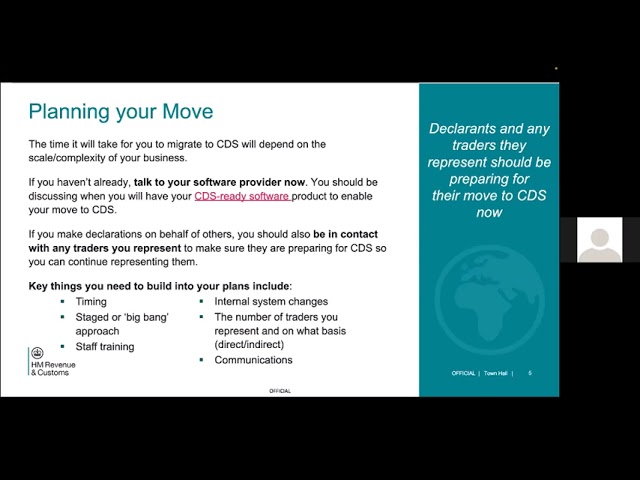
Watch HMRC explain the new Customs Declaration Service (CDS), set to enter into operation in Autumn 2022. What do you need to do? If your business is affected by this change, you need to know how it will affect you and what steps you need to take. We've put together a guide that explains everything you need to know about CDS, which you can download here: [link]. During the Customs & Global Trade Update Conference of Spring 2022, a live audience of over 100 customs and global trade experts joined HMRC for a presentation and discussion on the new Customs Declaration Services (CDS) due to enter into operation in Autumn 2022. In this video, you'll hear from HMRC, who will explain how businesses can get ready for CDS. The video covers: What is CDS? Why is it important? How does it work? How can businesses prepare themselves for its launch? Watch now: Read More Need to appoint a customs broker, agent or representative? What to think about.... Selecting the right partner to manage your imports and exports is crucial for trade success. There are some essential points to consider, argues Arne Mielken from Customs Manager Ltd. Ask the Customs Agent: Your TOP 7 customs clearance questions answered! Lodging import and export declarations must not be complicated. We answer businesses' top questions on customs clearance. Switching to the UK's CDS? Questions To Ask, Actions To Take The new UK customs declaration system is going live. In this blog, discover actions importing and exporting businesses may need to take now. How We Can Help We also offer a wide range of training and bespoke support on all things related to customs & Global Trade. Schedule a free call with us today to get practical advice from experts who understand the challenges faced by businesses like yours. www.customsmanager.org
- Need to appoint a customs broker, agent or representative? What to think about....
Selecting the right partner to manage your imports and exports is crucial for trade success. There are some essential points to consider, argues Arne Mielken from Customs Manager Ltd. Import and export declarations can be handled on your behalf by customs brokers or agents. Because customs filings may be difficult, many firms choose to hire an intermediary. You can pay someone or a company to handle customs for you, such as: freight forwarders customs agents or brokers fast parcel operators What they can do for you (and who will be liable) depends on: the services they provide what you want them to do the commercial agreement you have with them. Learn how to minimise delays, halt duty payments, and rectify false customs declarations from the outset with our broker management course, which is given in five convenient online courses including live training and a "check your knowledge" exam at the conclusion and a certificate of accomplishment. Find out more and how to book What type of relationship? They can act for you either as a: direct representative / agent indirect representative / agent They are unable to act on your behalf unless you provide them with written instructions. The command must specify whether they are operating directly or indirectly for you. Customs authorities may request proof of authorization. What shall I consider before appointing an agent? Before appointing one, there are several things to consider, such as: your company's requirements - the number of commodities moved, the sort of products moved, how frequently they are moved, and where they are moved to or from the number of declarations you plan to make for licencing whether your products require a permit, special handling, or other specialised controls Timing - If your items must arrive within a specified timetable, your customs training is required. Being clear on these points will allow you to make an informed decision when appointing an intermediary to help you with customs processes for Your business requirements Before speaking with a customs agent, make sure you have adequate information about your requirements, including what sort of items you transfer, how frequently you move them, and where you move them to or from – for example, the country with whom you frequently deal. You should think about asking your "middleman": "How much customs experience do you have?" What kind of items do you transport? Which routes/countries do you service? Can you manage the customs processes for the nations with whom I do business? How many declarations you need to make You need to know: how many declarations do you anticipate making in a week or month how frequently you transport items into and out of our nation You should also be clear about how the broker will charge for their services. Consider asking them Can you manage the number of declarations I intend to make? How would you like to be compensated (you should be able to estimate this for them)? They may, for example, impose a flat price, a fee per declaration, or both. Consider hiring Customs Manager to serve as your customs clearing agent. We provide brokerage services to our clients. Our unique selling point is that we only use fully certified customs managers and specialists to perform your customs clearance, rather than entry clerks with limited expertise. So, if you want a real customs manager who understands customs clearance to do the work for you, get in touch and explore more here. Licensing, special handling and other controls You must determine if your items require a licence, special handling, or other specialised regulations. Consider requesting confirmation from the broker that they will be able to manage your licencing requirements. Timing – goods that need to arrive quickly Think about if your goods need to arrive at their destination within a specific timeframe or need rapid or out-of-hours changes. You should consider asking the intermediary: can you prioritise declarations for goods that, for example, need to reach their destination within a specific timeframe? are you able to respond quickly to unforeseen issues that may arise while goods are being imported or exported? What you need from a broker Consider what you need your customs intermediary to perform, and what you can do yourself or have someone else do for you. You might think about asking the broker, "What is the whole range of services that you provide?" What would you and the intermediary be held accountable for? (For example, who would be in charge of import/export declarations, safety and security declarations, and transportation requirements?) Information sharing Consider the most convenient method for you to communicate information to your intermediary in order for them to act on your behalf and whether it will also work for them. You should think about asking the intermediary: What information do you require from me? How frequently will you require information from me? Can I offer the information in a method that is convenient for me? Free Videocast: Shall I appoint an agent or clear it alone? Watch this informative conversation between Business Journalist Paul and Customs Declaration Expert and "Broker Management Course" designer and leader Arne Mielken on who and how to file customs declarations. Customs Clearance Services by Customs Manager Ltd. We are experts in completing customs declarations for firms in the EU and the United Kingdom. To file customs declarations for our customers and comply with all UK fiscal filing and security filing regulations, we use leading electronic customs filing software that is directly connected to the UK's HM Revenue and Customs (HMRC). Our import, export, and transit filing services are tailored to your specific needs. Let's make it happen, whether you're a small dealer with a limited number of shipments or a huge and complicated international corporation with hundreds of shipments every week. We operate with a team of seasoned customs filing professionals, and each of our customers is assigned a Customs Manager for personalised service. Find out more: https://www.customsmanager.org/customs-filing-declaration-service Study the Course to Learn More A single blog article on this subject is absolutely insufficient. With our five-week training course, you'll gain a lot more knowledge on how to miss out on good broker advice. Find out more Get our free newsletter Head over to www.customsmanager.org and pop your e-mail address into the page for more insightful content, tips and tricks like this.
- BIFA's Guide the Customs Representation
The following information has been issued by BIFA to help their Members in understanding their legal obligations and liabilities as a Customs agent. The principal legislation controlling Customs operations will shift from EU Directive 952/2013 to the Taxation (Cross Border) Trade Act 2018 on January 1, 2021. (TCTA 2018).
- EU Sanctions On Russia: What are the top 5 questions that companies are asking? + Answers & BONUS
There are five critical questions that any EU firm working with Russia must be able to answer. You can find them right here. One of the biggest problems with EU sanctions is their complexity. The EU has a wide range of sanctions against Russia, and there are often confusing overlaps between them. Let's get the bottom of it, by answering questions that businesses and global trade professionals are actually asking. Hey, BTW if you are contemplating taking over Eastern Ukraine (or more), annexing the territory to assert sovereignty, and then reintroducing the downtrodden people of Donetsk and Luhansk into Mother Russia's loving arms, you should be aware of the sanctions imposed by the European Union. What are sanctions? Sanctions. Wars have been fought to put a stop to them, economies have suffered as a result of depending on them, and political careers have been damaged as a result of adopting them. The EU is no stranger to sanctions: in the last 50 years, the EU has sanctioned over a hundred nations and groups of persons. As a consequence, the phrase "sanctions" may refer to a variety of government actions ranging from travel bans to asset freezes and even trade restrictions. As soon as it seems that a penalty is about to be removed or has been lifted, another one is placed without notice. It's no surprise that sanctions are a hot subject in the media and in politics...especially when it comes to dealing with Russia... Why Sanctions Against Russia? Since Russia's recognition of the non-government-controlled portions of Ukraine's Donetsk and Luhansk oblasts on February 21, 2022, and the unprovoked and unlawful invasion of Ukraine on February 24, 2022, the EU has placed a slew of sanctions on Russia. They are in addition to the sanctions placed on Russia since 2014 in response to the annexation of Crimea and the failure to execute the Minsk accords. The EU denounced the "decision of the Russian Federation to recognise as independent entities and send Russian troops to certain areas of Ukraine’s Donetsk and Luhansk oblasts" as illegal and unacceptable. According to the EU, "it violates international law, Ukraine’s territorial integrity and sovereignty, Russia’s own international commitments, and it further escalates the crisis". Statement of the EU 24 February 2022 So far, what sanctions has the EU imposed? From February 2022 to May 2022, the EU has issued five packages of sanctions on Russia since February, including targeted restrictive measures (individual sanctions), economic penalties, and diplomatic measures. In reaction to Belarus's role in the invasion of Ukraine, the EU imposed sanctions on the country, too. Access a full debrief on the latest in Belarus Sanctions here. For what aim? The goal of the economic sanctions is to Punish Russia severely for its conduct Effectively block Russia's ability to continue its aggression. Target people responsible for supporting, financing or implementing actions which undermine the territorial integrity, sovereignty and independence of Ukraine or who benefit from these actions. What are the top 5 questions that companies are asking? Who can I still do business with and who not? Who can I protect my business and myself? As a business owner, what do I need to know about the trade with Russia? How are EU regulations affecting commerce with Russia, and what kind of import and export restrictions are in place? How can I still transport goods to Russia? Can I Still Get Paid? What do I need to know about trading with Crimea and the "breakaway" regions? BONUS: Other sanctions against Russia 1. Who Can I Still Do Business With and Who Not? RPS = Restricted Party Screening is required for firms interacting with Russia in order to prevent trading with certain categories of people. As of the beginning of May 2022, the EU sanctioned 80 organisations and 1093 individuals in total, including prior individual sanctions imposed following the annexation of Crimea in 2014. Please review our detailed explainer blog entry here. 2. As a business owner, what do I need to know about the trade with Russia? The EU has placed a number of import and export restrictions on Russia as part of the economic measures. Investigate what you can and cannot do. Because of the limitations, European firms are not permitted to sell certain items to Russia (export restrictions), and Russian entities are not permitted to sell some products to the EU (import restrictions). Please refer to our exclusive EU import and export guide for trade in goods with Russia. Read it here. 3. How Can I Still Transport Goods To Russia? You can't simply transfer merchandise to Russia and ignore EU sanctions regulations, can you? Otherwise, a catastro-pocalypse is a distinct possibility! And if you're still confused about the new regulations and penalties, you've come to the correct spot. The EU has recently issued fresh instructions directed primarily at airlines, yachts, and road transport providers to ensure that they are aware of the dangers involved with violating the Russia/Ukraine-related sanctions regime, which, in fact, has been in effect since July 2014. Explore the impact on planes, ships and road transport. 4. Can I Still Get Paid? To restrict the funding of escalatory and aggressive activities, the EU sanctions target banks that finance the Russian military and other operations in those regions, as well as the capacity of the Russian state and government to access the EU's capital and financial markets and services. This includes a sectoral embargo on funding Russia, its government, and its Central Bank. As a result, receiving money may be more challenging than you anticipate. Here are a few things to consider before signing a contract. Read the analysis and major choices that were made. 5. What do I need to know about trading with Crimea and the "breakaway" regions? Finding individuals responsible for the illegal and unfriendly conduct in Crimea and the two self-proclaimed republics is no easy task. As a result, the EU has amended its sanctions policy against Russia in response to their unlawful actions. So, now the EU targets commerce to and from Crimea and the two separatist regions in order to ensure that those responsible bear the economic costs of their unlawful and hostile acts. This impacts businesses which may or may not know that they trade with these regions. Read what you can and cannot do as a business owner. Takeaway Companies all throughout the world ask themselves the same Top 5 questions whenever there is a risk of fines. We went through the questions and gave answers to help you understand the sanctions imposed by the EU on Russia. Overall, it is clear that foreign firms operating in Russia face significant hurdles. And in this circumstance, it's doubtful that will change very soon. The first and most important step for any company interested in doing business with Russia is to double-check the products it produces and the marketplaces in which they are sold. If they are susceptible to these fines, customs officers who are seeking to enforce them may stop them. Next, regardless of how these sanctions effect your company's products trade, if you conduct business in Russia, you should be on the alert for other developments involving EU sanctions laws against Russia, such as payment restrictions. Individual trade or transportation restrictions The devil is in the details, but thanks to your Customs Manager subscription, you will always be up to date and knowledgeable. And if you have any questions, please contact us. BONUS1 : Other Sanctions against Russia There are a range of other sanctions imposed against Russia, too, to do with Human Rights abuses and more. Read our briefing. BONUS 2: In a Nutshell: Useful Infographics by the EU The below infographics provide a very useful overview of sanctions imposed by the EU on Russia.
- EU Sanctions: Attention - No trading with Crimea or Donetsk and Luhansk breakaway regions
The EU targets trade from Crimea and the two breakaway regions to and from the EU, to ensure that those responsible clearly feel the economic consequences of their illegal and aggressive actions. Restrictions on economic relations with the non-government controlled areas of the Donetsk and Luhansk oblasts Measures target trade from the two non-government controlled regions to and from the EU, to ensure that those responsible clearly feel the economic consequences of their illegal and aggressive actions. The EU introduced, in particular, an import ban on goods from the non-government controlled areas of the Donetsk and Luhansk oblasts, restrictions on trade and investments related to certain economic sectors, a prohibition to supply tourism services, and an export ban for certain goods and technologies. Crimea Since March 2014, the EU has progressively imposed restrictive measures in response to the illegal annexation of Crimea, Russia's decision to recognise the non-government controlled areas of Donetsk and Luhansk oblasts as independent entities and the deliberate destabilisation of Ukraine. The EU has imposed different types of restrictive measures: diplomatic measures individual restrictive measures (asset freezes and travel restrictions) restrictions on economic relations with Crimea and Sevastopol economic sanctions restrictions on economic cooperation Below you can find more information on each type of restrictive measures. Diplomatic measures In 2014, the EU-Russia summit was cancelled and EU member states decided not to hold regular bilateral summits with Russia. Bilateral talks with Russia on visa matters, as well as on the new agreement between the EU and Russia, were suspended. Instead of the G8 summit in Sochi, a G7 meeting was held - without Russia - in Brussels on 4-5 June 2014. Since then, meetings have continued within the G7 process. EU countries also supported the suspension of negotiations over Russia's joining the Organisation for Economic Co-operation and Development (OECD) and the International Energy Agency (IEA). Individual restrictive measures Asset freezes and travel restrictions 555 people and 52 entities are subject to an asset freeze and a travel ban because their actions have undermined Ukraine's territorial integrity, sovereignty and independence. The list of sanctioned persons and entities are kept under constant review and are subject to periodic renewals by the Council. These measures were introduced in March 2014. They were last extended until 15 March 2022. List of persons and entities under EU restrictive measures over the territorial integrity of Ukraine (Official Journal of the EU) Misappropriation of Ukrainian state funds In March 2014, the Council decided to freeze the assets of individuals responsible for the misappropriation of Ukrainian state funds. These measures were last extended in March 2020 until 6 March 2022. Restrictions on economic relations with non-government controlled areas of Donetsk and Luhansk The Council adopted restrictive measures in response to the decision by the Russian Federation to proceed with the recognition of the non-government controlled areas of Donetsk and Luhansk oblasts in Ukraine as independent entities, and the ensuing decision to send Russian troops into these areas. The scope of the measures is limited to the non-government controlled territories of Donetsk and Luhansk oblasts. These measures include: an import ban on goods restrictions on trade and investment related to certain economic sectors a prohibition on supplying tourism services an export ban on certain goods and technologies Restrictions on economic relations with Crimea and Sevastopol The Council adopted restrictive measures in response to the illegal annexation of Crimea and Sevastopol by the Russian Federation. The measures apply to EU nationals and EU-based companies. Their scope is limited to the territory of Crimea and Sevastopol. These measures include: an import ban on goods restrictions on trade and investment related to certain economic sectors and infrastructure projects a prohibition on supplying tourism services an export ban on certain goods and technologies On 21 June 2021, the Council extended these measures until 23 June 2022. Economic sanctions targeting exchanges with Russia in specific economic sectors In July and September 2014, the EU imposed economic sanctions targeting exchanges with Russia in specific economic sectors. In March 2015, EU leaders decided to align the existing sanctions regime to the complete implementation of the Minsk agreements, which was scheduled for the end of December 2015. Since this did not happen, the Council extended the economic sanctions until 31 July 2016. The economic sanctions have been extended successively for six months at a time since 1 July 2016. The decision to extend them was made each time following an assessment of the implementation of the Minsk agreements. The economic sanctions are currently extended until 31 July 2022. These restrictive measures: limit access to EU primary and secondary capital markets for certain Russian banks and companies impose an export and import ban on trade in arms establish an export ban on dual-use goods for military use or military end users in Russia curtail Russian access to certain sensitive technologies and services that can be used for oil production and exploration On 23 February 2022, the Council decided to introduce a sectoral prohibition on financing the Russian Federation, its government and Central Bank. By restricting the ability of the Russian state and government to access the EU’s capital and financial markets and services, the EU aims to limit the financing of escalatory and aggressive policies. Measures concerning economic cooperation Restrictions on economic cooperation were introduced by EU leaders in July 2014: the European Investment Bank (EIB) was requested to suspend the signing of new financing operations in the Russian Federation EU member states agreed to coordinate their positions within the European Bank for Reconstruction and Development (EBRD) Board of Directors with a view to also suspending the financing of new operations the implementation of EU bilateral and regional cooperation programmes with Russia was re-assessed and certain programmes suspended.